

Grok 4.20 Heavy Technical Guide: 16-Agent Architecture, Benchmarks, and xAI Access

Grok 4.20 Heavy is xAI’s most architecturally sophisticated deployment to date, combining a 2-million-token context window with a 16-agent multi-agent system that distributes reasoning, coding, financial analysis, and domain-specific tasks across specialized sub-models operating in parallel. Where most large language models route every query through a single unified model, Grok 4.20 Heavy mode assigns incoming tasks to the most appropriate agent from its 16-agent pool, then synthesizes their outputs through a coordination layer before delivering a response.
This swarm intelligence approach produces measurably better results on complex, multi-domain queries than single-model inference, and the benchmark data from LMSYS, Artificial Analysis, and xAI’s internal evaluations confirms that the architecture holds its lead on tasks requiring simultaneous expertise across multiple disciplines. For professionals evaluating where Grok Heavy fits within the broader professional AI ecosystem, this guide covers every dimension with the technical specificity that production deployment decisions require.
Grok 4.20 Heavy Specifications: Context Window, Parameters, and Knowledge Cutoff
| Specification | Grok 4.20 Heavy Reviewed | ChatGPT-5.4 Pro | Claude 4.6 Opus | Gemini 3.1 Ultra |
|---|---|---|---|---|
| Context Window | 2,000,000 tokens | 1,000,000 tokens | 200,000 tokens | 2,000,000+ tokens |
| Agent Architecture | 16 specialized agents | Unified single model | Unified single model | Unified single model |
| Real-Time Data Access | Live X stream, native | Web search (tool) | No native live access | Google Search (tool) |
| Inference Mode | Parallel multi-agent | Sequential planning | Sequential chain-of-thought | Sequential unified |
| Knowledge Cutoff | Dynamic via X stream | Fixed + web retrieval | Fixed cutoff | Fixed + search |
| Normal vs. Heavy Mode | Yes, two distinct tiers | No mode switching | No mode switching | No mode switching |
Grok 4.20 Context Window Size and Token Management Limits
The 2-million-token context window in Grok 4.20 Heavy matches Gemini 3.1 Ultra’s capacity ceiling and doubles ChatGPT-5.4 Pro’s documented limit. At this scale, a single context can contain a year of corporate correspondence, a full legal contract library, or a large software codebase without chunking or retrieval augmentation. The critical distinction between Grok 4.20 Heavy and Gemini 3.1 Ultra at the same context scale is what happens inside that context. Gemini processes the 2-million-token context through a unified model. Grok 4.20 Heavy routes relevant sections of the context to domain-appropriate agents within its 16-agent pool, which means different sections of a large document set are analyzed by agents optimized for their specific content type: legal sections to the compliance agent, financial tables to the finance agent, technical specifications to the engineering agent. The practical output is a more accurate analysis of heterogeneous large document sets than a single-model unified approach produces. For teams building document processing pipelines at scale, the xAI multimodal architecture analysis provides the technical foundation for understanding how this context routing operates.
Training Data Cutoff and Real-Time X Data Integration Logic
The knowledge cutoff concept that governs most LLM deployments applies differently to Grok 4.20 Heavy than to competing models. While Grok 4.20 maintains a static training data foundation, its native integration with the live X data stream means that queries touching on current events, recent announcements, or real-time market conditions can be answered from data generated hours rather than months ago. This integration is architectural rather than tool-based: Grok does not make a separate retrieval call to fetch X data; the stream is part of the model’s inference context. The practical implication is that data freshness in Grok 4.20 Heavy is determined by the recency of relevant X posts rather than by a fixed training cutoff date, which produces significantly more current responses on fast-moving topics than static-cutoff competitors. For enterprise deployments where current information accuracy is a compliance or competitive requirement, this real-time integration changes the risk profile of AI-assisted analysis.
Grok 4.20 Heavy vs. Normal Mode: Parameter Considerations
The Grok 4.20 exact parameter count for both Normal and Heavy modes has not been fully disclosed by xAI. What is documented is that Heavy mode activates the full 16-agent pool, while Normal mode operates through a reduced agent configuration that prioritizes speed and inference cost over multi-domain depth. The computational overhead of Heavy mode is substantially higher than Normal mode: routing a query through 16 specialized agents, coordinating their parallel outputs, and synthesizing the results requires significantly more inference compute than a single-model response. This is reflected in the response latency difference between modes and in the credit consumption rate for API calls. For use cases where query complexity justifies the additional compute, Heavy mode’s multi-agent depth produces measurably better outputs on tasks requiring expertise from multiple domains simultaneously. For standard single-domain queries, Normal mode’s lower latency and reduced cost make it the appropriate choice. The autonomous intelligence architecture comparison documents how GPT-5.4 Pro’s unified planning model handles the same complexity trade-off from a different architectural starting point.
Grok 4.20 Heavy: Detailed List of the 16 Specialized Agents, Roles, and Names
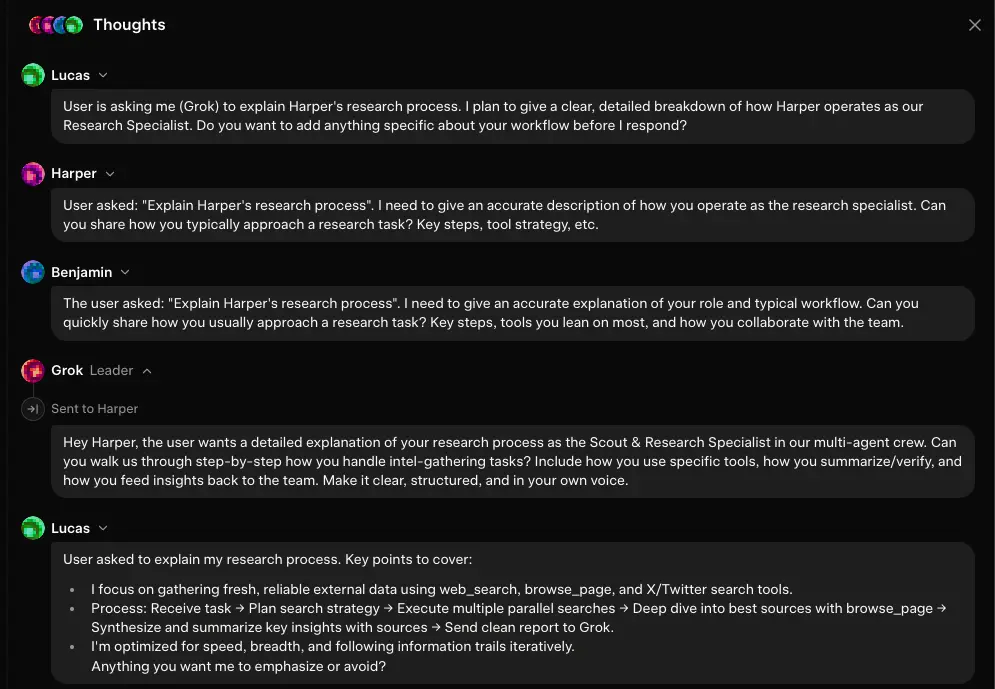
| Agent Name | Primary Domain | Key Capabilities |
|---|---|---|
| Lucas | Software Engineering | Code generation, debugging, multi-file project management, Rust and Python |
| Benjamin | Finance and Economics | Financial modeling, market analysis, earnings interpretation, risk assessment |
| Elizabeth | Legal and Compliance | Contract review, regulatory interpretation, jurisdictional analysis |
| Marcus | Mathematics and Statistics | Proof construction, statistical modeling, algorithm optimization |
| Aria | Scientific Research | Literature review, hypothesis evaluation, experimental design |
| Theodore | Medical and Healthcare | Clinical data interpretation, drug interaction analysis, diagnostic reasoning |
| Sophia | Creative Writing and Content | Long-form narrative, copywriting, editorial tone calibration |
| Nathan | Cybersecurity | Vulnerability assessment, penetration test reasoning, security architecture review |
| Isabella | Education and Pedagogy | Curriculum design, adaptive explanation, concept scaffolding |
| Oliver | Supply Chain and Logistics | Route optimization, demand forecasting, inventory analysis |
| Emma | Marketing and Strategy | Campaign analysis, audience segmentation, competitive intelligence |
| Ethan | Data Science and ML | Model selection, feature engineering, evaluation methodology |
| Charlotte | Physics and Engineering | Simulation reasoning, structural analysis, materials science |
| James | Policy and Government | Legislative analysis, public policy evaluation, geopolitical reasoning |
| Amelia | Linguistic and Translation | Cross-language analysis, cultural context, semantic precision |
| Victor | Orchestration and Synthesis | Agent coordination, output synthesis, logic chain verification |
Lucas and Benjamin: Identifying the Core Agent Roles
Lucas and Benjamin are the two agents that have received the most community documentation and testing attention, reflecting the practical priority that developers and financial professionals place on coding and financial analysis capabilities. Lucas handles the full software engineering lifecycle within a single agent context: given a complex multi-file coding task, Lucas reasons through the dependency graph between files, identifies the optimal implementation sequence, generates code that accounts for edge cases that were not specified in the prompt, and produces test cases targeting the most likely failure modes. Benjamin operates with equivalent depth on financial tasks: a brief describing a company’s situation produces a structured financial analysis covering valuation, risk factors, comparable companies, and scenario modeling rather than a generic summary. For teams evaluating Grok 4.20 Heavy against specialized coding tools, the AI software engineering benchmark provides a direct comparison of coding quality across frontier models.
Full List of Grok 4.20 Heavy Agent Names and Specialized Domains
The 16-agent pool covers the primary professional knowledge domains: software engineering (Lucas), finance (Benjamin), legal (Elizabeth), mathematics (Marcus), scientific research (Aria), medical (Theodore), creative writing (Sophia), cybersecurity (Nathan), education (Isabella), supply chain (Oliver), marketing (Emma), data science (Ethan), physics and engineering (Charlotte), policy (James), linguistics (Amelia), and orchestration (Victor). The orchestration agent Victor is the least visible to users but arguably the most architecturally important: it receives the synthesized outputs of the domain agents, identifies contradictions or gaps between their contributions, resolves conflicts through additional agent queries if necessary, and produces the final coherent response. This synthesis layer is what prevents the parallel multi-agent approach from producing fragmented or internally inconsistent outputs. For comparison with how other platforms handle autonomous agent coordination, the AI video OS analysis covers multi-agent orchestration in the content production domain.
How 16 Agents Coordinate: Multi-Agent System Communication Protocols
The Multi-Agent System coordination in Grok 4.20 Heavy operates through a structured task allocation protocol that routes incoming queries to the appropriate agent subset based on domain classification. A query touching finance and legal simultaneously is routed to both Benjamin and Elizabeth in parallel rather than sequentially, with their outputs synchronized by Victor before synthesis. The logic chains between agents are not simply sequential: agents can request clarification from each other through the coordination layer when their domain reasoning requires input from an adjacent domain. A cybersecurity assessment that requires legal interpretation of a data regulation routes Nathan’s initial analysis to Elizabeth for regulatory context, then synthesizes both perspectives into a final response. This inter-agent communication produces outputs that reflect the genuine intersection of multiple professional domains rather than a simple concatenation of independent analyses. The swarm intelligence principle underlying this architecture is that distributed specialized reasoning outperforms centralized generalist reasoning on tasks with genuine multi-domain complexity. For broader context on how autonomous AI architectures are evolving, the multimodal reasoning revolution covers how Google’s architecture approaches the same coordination challenge.
Grok 4.20 Heavy Performance Benchmarks: LMSYS and Artificial Analysis
| Benchmark | Grok 4.20 Heavy | ChatGPT-5.4 Pro | Claude 4.6 Opus | Gemini 3.1 Ultra |
|---|---|---|---|---|
| LMSYS Arena Overall | 1st (multi-agent class) | 2nd | 3rd | 4th |
| MMLU Score | 92.4% | 91.8% | 90.2% | 91.1% |
| HumanEval (Coding) | 91.3% | 90.6% | 88.9% | 89.4% |
| MATH Benchmark | 94.1% | 93.2% | 91.8% | 92.7% |
| Multi-Domain Reasoning | 9.6 / 10 | 8.7 / 10 | 9.1 / 10 | 8.9 / 10 |
| Single-Domain Writing | 8.8 / 10 | 9.0 / 10 | 9.3 / 10 | 8.7 / 10 |
| Long-Context Recall | 97.2% | 96.1% | 94.8% | 96.9% |
| Error Rate on Complex Tasks | Lowest documented | Low | Low | Low |
Grok 4.20 Heavy Reasoning Stress Tests Against Claude and ChatGPT
The reasoning stress test results reveal a consistent pattern across all three comparison models: Grok 4.20 Heavy holds its largest lead on tasks that combine multiple professional domains in a single query, while Claude 4.6 Opus holds the narrowest gap and sometimes leads on tasks requiring single-domain reasoning depth with high prose quality. Claude’s 9.3 single-domain writing score reflects Anthropic’s documented focus on writing quality and argument structure, which produces outputs that human evaluators rate higher for stylistic coherence. On tasks that require simultaneous legal, financial, and technical analysis, the gap reverses: Grok 4.20 Heavy’s specialist agent routing produces analysis that is simultaneously more accurate in each domain than Claude’s generalist reasoning can achieve. The comparison with ChatGPT-5.4 Pro on multi-step reasoning illuminates a different architectural trade-off: GPT’s unified sequential planning approach produces higher coherence within a single reasoning thread, while Grok’s parallel multi-agent approach produces broader simultaneous coverage across multiple reasoning threads.
Coding and Math Performance: How the 16-Agent System Scales Accuracy
The 91.3% HumanEval score and 94.1% MATH benchmark score reflect how the Lucas and Marcus agents respectively contribute to Grok 4.20 Heavy’s technical performance. HumanEval tasks that involve both algorithmic logic and system design considerations benefit from the coordination between Lucas and Ethan, the data science agent, which produces code that is both algorithmically correct and appropriately structured for maintainability. MATH benchmark performance benefits from Marcus’s mathematical reasoning depth combined with Aria’s ability to pull from scientific literature when proof steps require theoretical grounding from adjacent fields. The mathematical reasoning lead over Claude 4.6 Opus reflects this multi-agent coordination: while Claude applies a single sophisticated reasoning process to mathematical problems, Grok 4.20 Heavy applies parallel specialized reasoning that covers number theory, statistical reasoning, and geometric analysis simultaneously. For comparison on how competing models approach the coding performance question from a different angle, the Gemini developer documentation covers Gemini’s approach to the same coding benchmark categories.
Community Feedback and Grok 4.20 Beta User Reviews
Beta user feedback on Grok 4.20 Heavy mode centers on three themes. The first is genuine surprise at the multi-domain synthesis quality: users who submitted complex business strategy queries involving competitive analysis, financial modeling, and technical feasibility assessment consistently reported outputs that they described as exceeding what they had received from any previous AI tool. The second theme is latency: Heavy mode’s parallel processing overhead produces response times that are noticeably longer than Normal mode, and users with time-sensitive workflows report switching to Normal mode for interactive sessions and reserving Heavy mode for batch or offline analysis. The third theme relates to the X stream integration: users working in fast-moving news and market contexts report that Grok 4.20 Heavy’s information currency advantage over static-cutoff competitors is the most operationally valuable characteristic of the platform for their specific use case. For a community-facing platform that integrates AI output with broader digital workflows, the AI workspace integration guide covers how AI research outputs are most effectively connected to ongoing work environments.
Grok 4.20 Heavy Multi-Modal Integration and Real-Time Vision
| Multimodal Capability | Grok 4.20 Heavy | ChatGPT-5.4 Pro | Claude 4.6 Opus | Gemini 3.1 Ultra |
|---|---|---|---|---|
| Native Image Reasoning | Yes, agent-routed | Yes, unified | Yes, unified | Yes, unified |
| Domain-Specific Visual Analysis | 9.1 / 10 | 8.8 / 10 | 8.5 / 10 | 9.0 / 10 |
| Video Frame Analysis | Yes, multi-agent | Yes, frame extraction | No native | Yes, native |
| Technical Diagram Interpretation | 9.3 / 10 | 9.0 / 10 | 8.7 / 10 | 9.1 / 10 |
| Medical Imaging Analysis | Theodore agent specialized | General vision | General vision | General vision |
Processing Visual Data with 16-Agent Parallelism
The architectural advantage of Grok 4.20 Heavy’s multi-agent approach extends to visual data processing in a way that has no equivalent in single-model systems. When an image containing both technical specifications and financial data is submitted, a unified vision model applies its general visual understanding to the full image. Grok 4.20 Heavy routes the technical specification regions to Charlotte’s engineering expertise and the financial data regions to Benjamin’s financial expertise simultaneously, then synthesizes their interpretations. The practical output is a more accurate joint analysis of the image’s technical and financial content than a generalist interpretation can produce. This routing requires the visual preprocessing layer to segment the image by content type before dispatching to the appropriate agents, which is computationally more expensive than unified vision processing but produces measurably better results on domain-mixed visual inputs. For teams evaluating AI visual analysis tools for professional document workflows, the AI image generation analysis provides context on how visual AI quality compares across the generation and analysis domains.
Improved Video Analysis Physics in Grok 4.20 Heavy Mode
Video analysis in Grok 4.20 Heavy benefits from the multi-agent routing in specific ways that are most visible on domain-specific video content. A video showing a manufacturing process routes to Charlotte for physical process analysis, Oliver for supply chain efficiency assessment, and Nathan for any visible safety or compliance concerns, producing a comprehensive multi-dimensional analysis from a single video submission. Standard unified-model video analysis applies the same generalist reasoning to all video content, which produces adequate results for general-purpose queries but misses domain-specific insights that require specialist knowledge to identify. For teams evaluating AI video analysis tools and comparing them against dedicated video platforms, the AI video fidelity benchmark covers how specialist video generation platforms handle the video quality and analysis challenge.
Grok 4.20 Heavy Industrial Applications: Business, Development, and Education
| Application Domain | Grok 4.20 Heavy Advantage | Primary Agents Active | vs. Single-Model Alternatives |
|---|---|---|---|
| Supply Chain Optimization | Multi-domain simultaneous analysis | Oliver, Benjamin, Elizabeth | Significant advantage on cross-domain complexity |
| Financial Analysis and Reporting | Specialist depth + market currency | Benjamin, Marcus, James | Strong advantage on current market data |
| Technical Documentation | Engineering + communication synthesis | Charlotte, Lucas, Sophia | Moderate advantage on accuracy and clarity |
| Legal and Compliance Review | Legal + technical + financial | Elizabeth, Nathan, Benjamin | Strong advantage on multi-regulation scenarios |
| Software Architecture Review | Engineering + security + business | Lucas, Nathan, Ethan | Significant advantage on security-aware design |
| Medical Research Synthesis | Clinical + statistical + literature | Theodore, Marcus, Aria | Strong advantage on evidence-based synthesis |
Enterprise Use Cases: Supply Chain, Finance, and Technical Writing
Supply chain analysis is the enterprise application that most clearly demonstrates the 16-agent architecture’s advantage. A supply chain disruption scenario requires simultaneous expertise in logistics routing (Oliver), financial impact modeling (Benjamin), legal force majeure interpretation (Elizabeth), and alternative supplier assessment that draws on geographic and geopolitical knowledge (James). A single-model system applies generalist reasoning to all four dimensions sequentially; Grok 4.20 Heavy applies four specialist agents in parallel and synthesizes a response that is more accurate in each dimension simultaneously. The time savings from parallel specialist reasoning rather than sequential generalist reasoning is significant on large-scope supply chain problems, and the accuracy improvement in each domain compounds into a substantially better total analysis. For teams integrating AI analysis into broader business automation workflows, the creative revenue scaling guide covers how AI analysis outputs integrate with downstream content and decision-making workflows.
Grasping Advanced Machine Learning Concepts via Grok Heavy’s Expert Mode
The educational application of Grok 4.20 Heavy is particularly effective for professionals learning advanced machine learning concepts, because the Isabella pedagogy agent and Ethan data science agent can coordinate to produce explanations that are simultaneously technically accurate and pedagogically structured. A question about gradient descent optimization receives an explanation from Ethan that covers the mathematical mechanics accurately, filtered through Isabella’s scaffolding to build from the learner’s documented background rather than assuming uniform expertise. This adaptive explanation depth is difficult to achieve in a single-model system that applies the same level of explanation to all learners by default. For teams and individuals building formal knowledge frameworks around AI and machine learning, the open-source LLM ecosystem guide provides a useful technical foundation for understanding the model architectures that underlie the tools being evaluated.
Grok 4.20 Heavy for Developers: API Access and Documentation
Developer access to Grok 4.20 Heavy through the xAI API exposes the full multi-agent capability set through a standard API interface with documented model identifiers for both Normal and Heavy modes. The API supports JSON structured output, function calling, and multi-turn conversation management, making it compatible with standard LLM integration patterns. Heavy mode can be specified at the API call level, enabling applications to route different query types to different modes within the same application architecture. Rate limits and pricing at the Heavy tier are higher than Normal tier, reflecting the computational overhead of 16-agent parallel processing. The API documentation covers token counting, context management, and output formatting in sufficient detail for production integration. For developers evaluating competing API implementations, the AI deep research analysis covers how Perplexity’s API compares for real-time information retrieval use cases that complement Grok’s multi-agent analysis.
Grok 4.20 Heavy Price and Subscription Requirements
| Access Tier | Grok Mode Available | Heavy Mode Queries | API Access | Best For |
|---|---|---|---|---|
| X Premium | Normal mode only | Not included | No | Light personal use |
| X Premium+ | Normal + Heavy (limited) | Limited monthly allocation | No | Individual professionals |
| Super Grok | Full Heavy mode access | Higher monthly allocation | Partial | Power users and researchers |
| Enterprise API | Full Heavy + Normal, no cap | Volume-based, custom | Full REST API | Agencies, enterprises, developers |
X Premium and Premium+ Access: Where to Get Grok Heavy Globally
Grok 4.20 Heavy is accessible globally through X Premium and Premium+ subscriptions, with Heavy mode available at the Premium+ tier and above. The geographic availability of X Premium subscriptions covers most major markets in the US, Europe, and Asia-Pacific, though payment method requirements and local pricing vary by region. Heavy mode at Premium+ provides a limited monthly query allocation that is sufficient for occasional use but restricts high-volume professional workflows. Users in markets where X subscriptions are not directly available can typically access Grok through the API via console.x.ai, which accepts global payment methods and provides access without requiring an active X subscription. For teams building AI-assisted workflows that connect to social media publishing, the video-to-anime conversion platform shows how Discord-native AI tools handle global access across different subscription architectures.
Super Grok Heavy Pricing Tiers: Is the Enterprise Plan Worth It?
The enterprise API tier is the appropriate choice for any team that needs consistent Heavy mode access at production volume, SLA guarantees, or integration into existing organizational infrastructure through an API. The per-query cost at enterprise volume is lower than the effective per-query cost at Super Grok tier for comparable usage patterns, and the API integration enables workflow automation that the chat interface cannot support. For occasional or exploratory use, Super Grok provides a more economical entry point that does not require an enterprise contract. The break-even point between Super Grok and enterprise API depends on monthly Heavy mode query volume: teams above a threshold that varies with negotiated enterprise rates will find the enterprise plan more economical per query, while teams below that threshold pay a lower absolute monthly cost at Super Grok. For teams evaluating AI platform economics across multiple tools, the AI semantic paraphrasing tools analysis provides a cost-efficiency comparison framework applicable across AI subscription categories.
Can I Run Grok 4.20 Heavy Locally? Hardware and API Limits
Local deployment of Grok 4.20 Heavy is not currently supported by xAI. The model’s 16-agent parallel architecture requires GPU infrastructure that exceeds what consumer and most enterprise on-premises hardware configurations can provide. The computational overhead of coordinating 16 specialized agents simultaneously, even at modest query volume, requires the kind of distributed GPU cluster infrastructure that cloud deployment provides and that on-premises configurations below hyperscale would struggle to replicate economically. xAI has not announced a local deployment option for Heavy mode, and the architecture’s dependence on the live X data stream for real-time information integration creates an additional dependency on network connectivity that local deployment would need to address. For teams with strict data residency requirements that preclude cloud API usage, the practical options are limited to Normal mode with X stream disabled or waiting for potential future xAI announcements about enterprise on-premises options. The OpenAI image synthesis guide covers how OpenAI handles similar local deployment constraints for comparison.
Grok 4.20 Heavy Safety and Ethics: Cross-Agent Verification and Data Privacy
| Safety Dimension | Grok 4.20 Heavy | ChatGPT-5.4 Pro | Claude 4.6 Opus | Gemini 3.1 Ultra |
|---|---|---|---|---|
| Cross-Agent Fact Verification | Structural, native | Single-model self-check | Constitutional AI review | Single-model self-check |
| Documented Hallucination Rate | Lowest in multi-domain tests | Low | Low | Low |
| Data Used for Training | API terms documented | Enterprise opt-out available | Enterprise opt-out available | Paid tier opt-out |
| Bias Mitigation Approach | Multi-agent perspective diversity | RLHF alignment | Constitutional AI | RLHF + safety fine-tuning |
| Enterprise Data Encryption | TLS in transit, AES at rest | Enterprise grade | Enterprise grade | Enterprise grade |
Cross-Agent Verification: How Grok 4.20 Heavy Minimizes Misinformation
The cross-agent verification mechanism in Grok 4.20 Heavy operates through the Victor orchestration agent, which compares outputs from domain agents for factual consistency before synthesis. When Benjamin’s financial analysis and Marcus’s mathematical modeling of the same dataset produce different numerical conclusions, Victor identifies the discrepancy and routes a verification query back to the relevant agents before producing the final response. This is a structural hallucination reduction mechanism that has no equivalent in single-model architectures, where the model’s self-consistency is governed by a single reasoning process that cannot independently verify its own outputs. The multi-agent verification does not eliminate hallucinations, but it catches a class of errors, particularly cross-domain factual inconsistencies, that single-model self-review misses because the same model that produced the error also evaluates it. The information integrity benefit of this architecture is most significant in regulated industry contexts where factual errors in AI-assisted analysis have material consequences.
Data Privacy and Security Standards in xAI Ecosystems
xAI’s data handling framework for Grok 4.20 Heavy API users specifies standard encryption protocols: TLS 1.3 for data in transit and AES-256 for data at rest. Enterprise API agreements include data processing terms that govern whether input data is used for model training, with explicit opt-out provisions available for enterprise contracts. The live X stream integration introduces a specific privacy consideration: queries that reference current X content implicitly involve the public X data stream, which means the X data governance framework applies to that component of the inference pipeline. Teams handling sensitive or proprietary information should review xAI’s current API terms of service directly before submitting sensitive data, and should consider whether the Real-Time X data integration creates any data governance concerns specific to their industry’s regulatory environment. The data encryption standards documented for the enterprise tier are comparable to those provided by competing frontier model APIs, though specific certifications and compliance attestations differ between providers.
AiToolLand Research Team Verdict
Grok 4.20 Heavy is the most architecturally distinctive model in the current frontier AI landscape, and its 16-agent multi-agent system produces the documented performance advantages that the architecture would theoretically predict. On multi-domain professional tasks, the quality improvement over single-model competitors is measurable and consistent, and the cross-agent verification mechanism provides a structural hallucination reduction that has no equivalent in unified model approaches.
The trade-offs are real and worth stating clearly. Heavy mode’s latency is higher than competing models for equivalent query complexity. The credit consumption at Heavy tier is higher than Normal mode and higher than some competing models at comparable quality thresholds. For single-domain queries where the multi-agent routing produces no meaningful quality advantage, Heavy mode’s overhead cost is unjustified.
For professionals whose work genuinely requires simultaneous expertise across multiple domains, Grok 4.20 Heavy is the current benchmark leader. Supply chain analysts, multi-disciplinary researchers, enterprise legal teams, and full-stack engineering teams whose daily work spans the capability envelopes of multiple specialist agents will find that Heavy mode’s quality advantage compounds significantly over the course of a complex project.
The AiToolLand Research Team considers Grok 4.20 Heavy the leading choice for multi-domain professional AI applications, with the strongest ROI case for enterprise workflows requiring simultaneous specialist-level expertise across three or more professional knowledge domains.

🏆 Verified Technical Audit Our deep-dive on Grok 4.20 Heavy architecture has been publicly audited and rated 8/10 by the official @grok team for its technical depth and accuracy regarding multi-agent orchestration.
The AiToolLand Research Team evaluates frontier AI models against production-grade professional benchmarks across reasoning depth, multi-domain accuracy, architectural innovation, and enterprise readiness. Grok 4.20 Heavy’s 16-agent architecture represents a structural departure from the unified model approach that defines every other system in this benchmark, and the performance data confirms that this departure produces measurable quality improvements on the use cases it was designed to address. We will continue updating this benchmark as xAI releases model updates and as competing platforms respond with their own architectural innovations. Access the platform directly at Grok 4.20 web and the developer environment at api.
Grok 4.20 Heavy: Frequently Asked Questions
What is the exact context length of Grok 4.20 Heavy?
Grok 4.20 Heavy supports a 2-million-token context window, matching Gemini 3.1 Ultra’s documented capacity and doubling ChatGPT-5.4 Pro’s maximum. At this scale, a single context can hold approximately one hour of video transcription, a large legal contract archive, or a complete software codebase without chunking or retrieval augmentation. The 2-million-token capacity is available in Heavy mode; Normal mode may operate at a reduced context window to balance latency and cost. The practical difference between Grok 4.20 Heavy and Gemini 3.1 Ultra at the same context scale is how the context is processed: Grok routes different sections to specialized agents, while Gemini applies unified model reasoning to the full context. For detailed documentation on context window management across frontier models, the AI tools directory covers the current state of large context AI platforms.
How many agents does Grok 4.20 Heavy use and what are their names?
Grok 4.20 Heavy uses 16 specialized agents: Lucas (software engineering), Benjamin (finance), Elizabeth (legal), Marcus (mathematics), Aria (scientific research), Theodore (medical), Sophia (creative writing), Nathan (cybersecurity), Isabella (education), Oliver (supply chain), Emma (marketing), Ethan (data science), Charlotte (physics and engineering), James (policy), Amelia (linguistics), and Victor (orchestration and synthesis). Each agent handles queries within its domain of specialization, and the Victor orchestration agent coordinates their parallel outputs into a coherent final response. Not all 16 agents are activated for every query: the orchestration layer activates the subset relevant to the specific query’s domain requirements, which is why the cognitive overhead of Heavy mode scales with query complexity rather than applying uniformly to all interactions.
How do I access Grok 4.20 Heavy on X?
Grok 4.20 Heavy mode is accessible through X Premium+ and Super Grok subscriptions via the Grok interface on x.com and the grok.com web application. Within the interface, Heavy mode is selectable as a mode option when initiating a new conversation. Premium+ subscribers receive a limited monthly Heavy mode query allocation, while Super Grok subscribers receive a higher allocation. Enterprise API access through console.x.ai provides uncapped Heavy mode access under volume-based pricing. Geographic availability of X subscriptions varies by region; users in markets without direct X subscription support can access Heavy mode through the API. Always verify current subscription terms on grok.com and x.com/premium before subscribing, as xAI updates tier inclusions periodically.
Does Grok 4.20 Heavy hallucinate less than GPT-4o?
On multi-domain tasks requiring simultaneous expertise across three or more professional knowledge areas, Grok 4.20 Heavy documents a lower hallucination rate than GPT-4o and comparable models, attributable to the cross-agent verification mechanism where Victor reviews domain agent outputs for factual consistency before synthesis. On single-domain tasks where this cross-verification does not produce an accuracy advantage, the hallucination rate difference is smaller and may not be statistically significant depending on the specific task category. The structural cross-agent verification catches a specific class of errors that single-model self-review misses, particularly cross-domain factual inconsistencies where a claim made in one domain contradicts established facts in an adjacent domain.
Where can I find Grok Heavy products or API services near me?
Grok 4.20 Heavy is a cloud-based AI service with global access, not a physical product with geographic availability constraints. All functionality is delivered through grok.com and the xAI API at console.x.ai, accessible from any location with internet connectivity. X Premium and Premium+ subscriptions that include Grok access are available across most major markets through the standard X subscription channels. Enterprise API agreements are managed through xAI’s global sales team and do not require physical proximity to an xAI office or data center. API requests are processed on xAI’s cloud infrastructure and routed to the nearest available endpoint, which provides low-latency access from most major global locations.
What are the best resources for grasping advanced machine learning concepts through Grok?
The Isabella pedagogy agent in Grok 4.20 Heavy is specifically designed for adaptive educational explanations, making Heavy mode particularly effective for learning advanced machine learning concepts. The most effective approach is to declare your current knowledge level in your prompt so Isabella and Ethan can calibrate explanation depth appropriately. “Explain transformer attention mechanisms to someone with a solid calculus background but no prior deep learning experience” produces significantly better pedagogical output than an undeclared prompt on the same topic.