

Gemini 3.1 Pro Technical Audit: Benchmarking the Reasoning Revolution
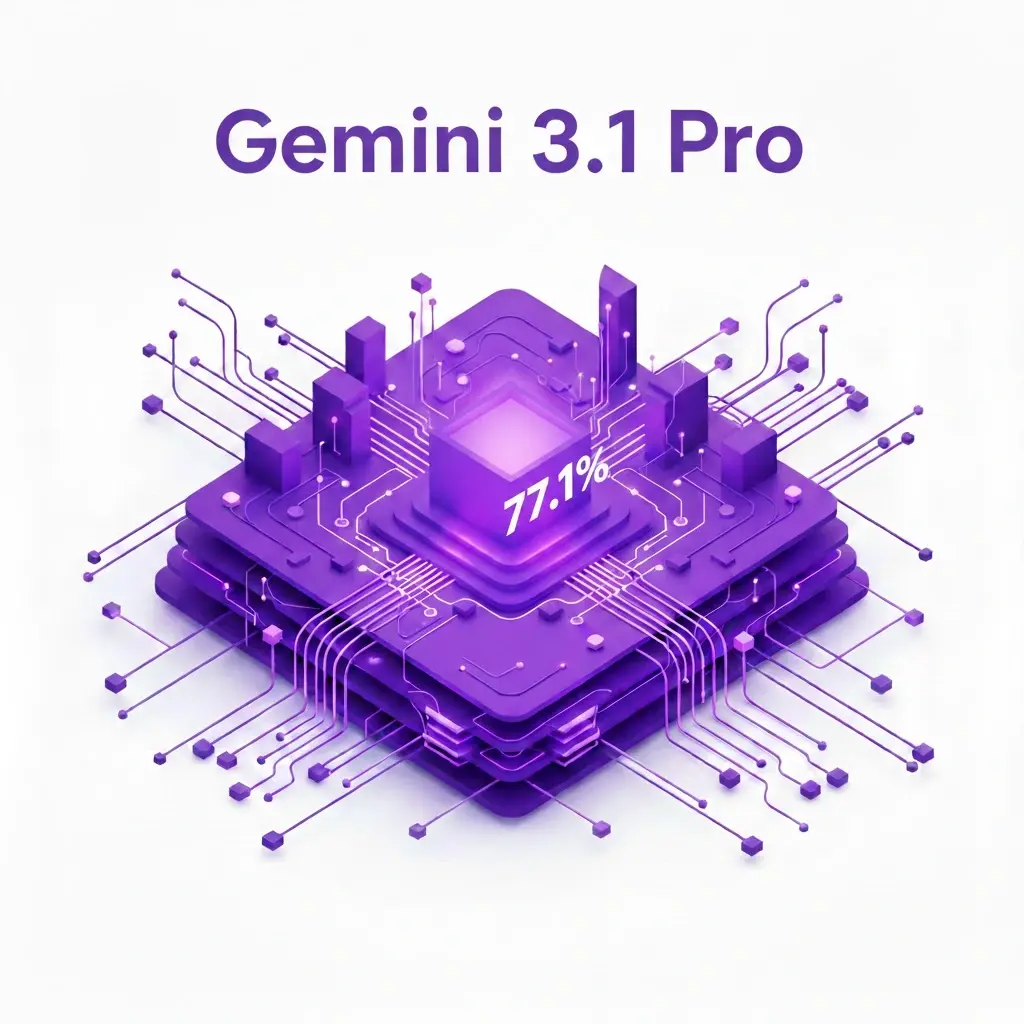
Following the major industry shift on February 19, 2026, Google DeepMind recently crossed a threshold the AI industry had been watching for years. Gemini 3.1 Pro arrived not with a consumer product launch or a viral demo, but with a benchmark sheet that rewrote what frontier models are expected to do with complex, multi-step logic. Meanwhile, Grok 4.20 has been quietly building the most sophisticated multi-agent verification architecture in commercial AI.
What follows is a technical audit of both systems not a feature list comparison, but a genuine architectural reckoning. Where does each model actually win? Where does the marketing diverge from the engineering reality? And critically: which system should you be building on right now?
Explore Gemini 3.1 Pro Insights ↓
What Is Gemini 3.1 Pro And Why Does It Mark a New Baseline for Complex Problem-Solving?
Bottom line: Gemini 3.1 Pro delivers more than double the reasoning performance of its predecessor across logic, mathematics, and novel problem-solving benchmarks. By achieving 77.1% on ARC-AGI-2 and best-in-class performance on Humanity’s Last Exam, it establishes a new frontier baseline that reframes what ‘capable’ means for production AI.
The ‘3.1’ designation matters more than it appears. In Google’s internal versioning logic, point releases typically signal targeted capability improvements rather than full architectural rebuilds. What makes 3.1 Pro unusual is the magnitude of the jump: this is a reasoning improvement more consistent with a major version than a patch. The model’s performance on novel logic tasks—problems specifically designed to resist pattern-matching—represents a qualitative shift in how the system approaches problems it has never structurally encountered before. This leap in spatial and logical reasoning directly empowers more sophisticated AI-powered creative design and content workflows, where complex layout decisions and semantic consistency are paramount. It is one of the strongest signals we have that the model is reasoning rather than simply retrieving from training data.
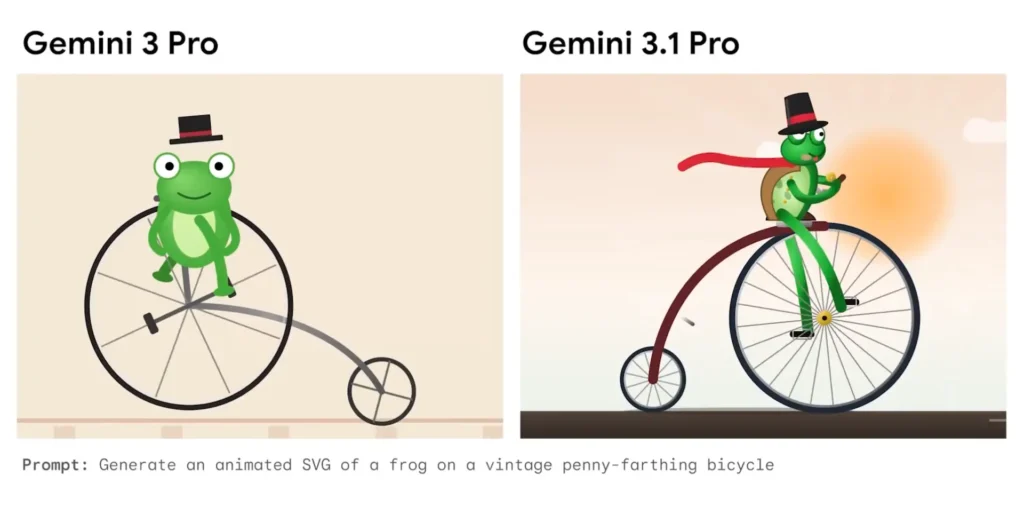
How Does Gemini 3.1 Pro Double Reasoning Performance? The “Thought Signatures” Explained
The most telling comparison isn’t against the older 2.0 generation it’s against Gemini 3 Pro, the November 2025 release. On ARC-AGI-2, Gemini 3 Pro scored 31.1%. Gemini 3.1 Pro scored 77.1%. That’s not incremental progress; it’s a generational jump compressed into a point release, and the velocity of improvement is itself the story.
The mechanism behind it is what Google calls “thought signatures” structured internal representations of reasoning steps that persist across the model’s forward pass. Rather than collapsing multi-step reasoning into a single prediction, the model maintains explicit intermediate states that can be referenced, revised, and verified before the final output is committed. These aren’t knowledge retrieval tasks they require constructing novel inference chains, holding intermediate conclusions in working memory, and backtracking when a path fails. Thought signatures are architecturally distinct from chain-of-thought prompting, which was always a prompt-level workaround; this mechanism is native to the inference process itself.
What Makes ARC-AGI-2 the Hardest AI Benchmark Right Now And Why 77.1% Is a Breakthrough
ARC-AGI-2 verified performance of 77.1% is the number that has generated the most discussion in the research community and for good reason. The ARC-AGI suite was specifically designed to resist training data contamination: each problem requires genuine abstract reasoning about visual and logical patterns the model cannot have memorized. Scoring above 75% was considered a meaningful threshold by the benchmark’s creators. Gemini 3.1 Pro cleared it jumping from Gemini 3 Pro’s 31.1% in a single point release.
On Humanity’s Last Exam constructed from graduate-level questions across mathematics, science, and humanities, explicitly designed to be unsolvable by retrieval alone Gemini 3.1 Pro achieved best-in-class performance at time of publication. Taken together, these results indicate a model that reasons rather than recalls, and that distinction has real consequences for the problems your organization actually needs to solve.
Quick Benchmark Comparison: Gemini 3.1 Pro vs. Grok 4.20 vs. GPT-4o
Bottom line: Gemini 3.1 Pro leads on reasoning benchmarks, coding autonomy, and context scale. Grok 4.20 Heavy retains an edge on verified multi-step STEM accuracy. Use this table as an orientation not a verdict since workload type ultimately determines which architecture wins.
| Benchmark | Gemini 3.1 Pro | Grok 4.20 Heavy | GPT-4o |
|---|---|---|---|
| ARC-AGI-2 | 77.1% | ~68% | ~61% |
| SWE-bench Verified | 80.6% | ~52% | ~55% |
| MATH (Reasoning) | 91.4% | 93.1% | 85.5% |
| Humanity’s Last Exam | Best-in-class | Competitive | Below frontier |
| Avg. Response Latency | ~300ms | 800ms–2s | ~400ms |
| Max Context Window | 2M tokens | 128K tokens | 128K tokens |
Unified Neural Network vs. 16-Agent Hierarchy: Which Architecture Actually Wins?
Bottom line: Gemini 3.1 Pro processes all modalities inside a single neural network, achieving sub-300ms latency with no inter-system handoff overhead. Grok 4.20’s 16-agent verification hierarchy catches more errors on complex STEM tasks but carries a latency tax of 800ms to 2 seconds. The decision comes down to whether your application needs speed or verified precision.
Sub-250ms Latency: The Competitive Edge of Native Signal Processing
A traditional AI pipeline processes audio, vision, and language through separate subsystems each handoff introducing buffering delays and information loss. Gemini 3.1 Pro’s native multimodal signal processing eliminates these handoffs entirely. Audio is encoded directly as spectral features; visual inputs are processed alongside text in the same transformer pass. The result sits below the threshold of perceptible conversational delay.
For teams building automated speech capture and transcription pipelines, real-time translation systems, or any application where the AI participates in a live interaction rather than running as a background processor, this latency profile is an architectural prerequisite not a minor advantage. Pipeline-based systems cannot close this gap through optimization; they can only minimize the overhead of their handoffs.
The Verification Tax: Why Grok 4.20 Prioritizes Depth over Response Speed
Grok’s verification hierarchy distributes a reasoning task across 16 specialized sub-agents, each approaching the problem from a different angle, then cross-validates outputs before surfacing a final response. On complex mathematical derivations and multi-step logical proofs, this architecture demonstrably reduces error rates. The cost is time: 800ms to over 2 seconds per response depending on problem complexity.
This is the right tradeoff for workloads where the cost of a confident wrong answer exceeds the cost of waiting formal verification, legal analysis, high-stakes financial modeling. For real-time AI assistant technology or any system where response velocity affects user experience, the latency tax becomes a structural liability. Knowing which side of this tradeoff your application sits on is the most important model selection decision you’ll make.
Why Is Gemini 2.0 Being Deprecated And What Does That Mean for Your Production Stack?
Bottom line: Model deprecation in modern AI infrastructure is accelerating. Gemini 2.0 Flash’s planned sunset reflects Google’s strategic shift toward a tiered portfolio Pro for complex reasoning, Flash-class for high-volume lower-complexity tasks. Teams still running 2.0 Flash in production need a migration roadmap now, not at deprecation.
Why Modern AI Frameworks Retire Models Faster Than Ever
The economics of foundation model development have changed fundamentally. Training runs at the frontier now cost hundreds of millions of dollars; maintaining parallel inference infrastructure for deprecated models while serving newer ones creates compounding overhead that is unsustainable at scale. As a result, Gemini 2.0 Flash deprecation follows a pattern that is now standard across the industry: a defined sunset window, a migration guide, and an expectation that production systems adapt on a set timeline.
For developers who built on Flash’s specific capability profile particularly its latency characteristics and cost-per-token economics this transition requires genuine architectural thinking, not a simple API swap. Understanding the model migration roadmap means first identifying which of your use cases actually require 3.1 Pro’s deeper reasoning and which are better served by a maintained Flash-tier successor in the 2.5 family.
From Flash to Pro: Selecting the Right Model for Production Environments
Production-grade AI deployment today is not a single-model problem. Current industry best practice points toward a tiered routing architecture: lightweight models handle high-volume classification, summarization, and retrieval; heavyweight reasoning models handle complex generation and autonomous agent orchestration. Gemini 3.1 Pro belongs decisively in the second tier. Routing every query through it is economically irrational; routing complex reasoning tasks through anything less is a quality compromise. Teams building on AI-driven content generation platforms or multi-step research pipelines should treat this migration as an opportunity to implement intelligent model routing not just a version number update.
| Use Case Category | Recommended Model | Strategic Reasoning |
|---|---|---|
| Complex Reasoning & Coding | Gemini 3.1 Pro | High-stakes autonomous agent orchestration and verified SWE-bench tasks. |
| High-Volume Data Analysis | Gemini 3.1 Pro | Native 2M token window prevents context fragmentation in large codebases. |
| Real-time Classification | Gemini 2.5 Flash | Optimized for sub-200ms latency and minimal cost-per-thousand-requests. |
| Content Summarization | Gemini 2.5 Flash | Sufficient semantic density for standard extraction without “Pro” overhead. |
| Legacy Flash Migration | 2.5 Flash / 3.1 Pro | Tiered routing: Use Pro for logic-heavy steps, Flash for simple I/O tasks. |
Does Gemini 3.1 Pro Finally Solve the “Ghost Data” Problem at 2M Token Scale?
Bottom line: Gemini 3.1 Pro significantly improves edge-case retrieval within its 2M token context window through thought signatures that maintain explicit references to distant context. Edge degradation is reduced but not eliminated. Explicit context caching cuts enterprise compute costs by up to 90% changing the economics of large-context deployments substantially.
Thought Signatures: Improving Retrieval Precision at the Extreme Edges
The persistent weakness of long-context models is at the edges: information loaded very early or very late in a massive context becomes functionally unreachable during inference, even when technically present. Gemini 3.1 Pro addresses this through thought signatures internal reasoning markers that create explicit references to distant context positions, effectively pinning important information so it remains accessible throughout a long inference session.
In needle-in-a-haystack precision tests, 3.1 Pro shows measurable improvement over 2.0 Flash beyond the 85th percentile of context length the range where previous models degraded most significantly. KV-cache compression and context slicing behaviors still apply in web-facing implementations, and users relying on consumer interfaces should not expect full 2M token fidelity. At the API level with explicit context management, the retrieval reliability improvement is real and expands the viable use case surface meaningfully.
Context Caching Economics: How Explicit Caching Cuts Enterprise Costs by 90%
For applications that repeatedly process a stable, large context a regulatory compliance corpus, a multi-file codebase, a brand knowledge base explicit context caching stores KV representations server-side between queries. The compute savings reach 90% for cache-heavy workloads because the model’s internal representation of the stable context is paid once, not per query. This changes the economics of large-context deployments that previously seemed cost-prohibitive. Teams building on core foundation AI model infrastructure at scale will find this the single most impactful cost lever available in the 3.1 Pro API.
How Does Project Astra’s Spatial Intelligence Work And Why Does It Matter Beyond Demos?
Bottom line: Project Astra builds a persistent, continuously updated semantic map of your physical environment not a video buffer, but a structured spatial index that enables associative retrieval, object tracking, and contextual environmental reasoning across sessions. Production applications in accessibility, field service, and wearable AI integration are already validated.
Persistent Visual Memory: Beyond Frame-by-Frame Image Analysis
Traditional computer vision treats each frame as an independent analysis problem. Astra treats your environment as a persistent object that accumulates state over time, encoding objects and their spatial relationships into a semantic index. Associative visual retrieval “where did I leave the hard drive?” works because the model maintains a location record, not because it replays footage.
In accessibility tooling, persistent spatial memory enables proactive environmental guidance for visually impaired users. In manufacturing and field service, it provides hands-free equipment tracking and procedural verification without dedicated IoT infrastructure. The situational partner model of AI interaction one that knows your environment as well as you do is no longer speculative. It’s in production.
Multimodal Live API: Integrating Real-Time Vision into Wearable Tech
The Multimodal Live API exposes Astra’s capabilities to third-party developers at production-grade latency, supporting streaming video input alongside audio and text while maintaining session state across a continuous interaction. This continuous visual processing logic shares deep architectural DNA with next-generation AI video synthesis tools, where understanding temporal consistency is as critical as frame-by-frame accuracy. It is the technical foundation for meaningful wearable AI integration—smart glasses that understand context, AR systems that annotate environments intelligently, and industrial headsets providing real-time procedural guidance.
For teams exploring generative video and visual AI applications at the edge, this API represents the most accessible entry point into persistent spatial intelligence that currently exists in any commercial platform.
What Does an 80.6% SWE-bench Score Mean for Autonomous Coding in Practice?
Bottom line: Gemini 3.1 Pro’s 80.6% SWE-bench Verified score means it can autonomously generate accurate patches for the majority of standard real-world software engineering tasks without human-in-the-loop guidance. Combined with 2M token context, it can hold entire medium-sized codebases in a single session and reason across file dependencies with production-grade reliability.
Autonomous Patch Generation: Achieving 80.6% on SWE-bench Verified
SWE-bench Verified consists of real GitHub issues from production repositories, requiring the model to understand existing code structure, identify bug root causes, and generate patches that pass the repository’s existing test suite without seeing the solution. An autonomous coding agent clearing 80% on this benchmark is not a code autocomplete tool. It is a system that can take a bug report and return a deployable fix without human intervention on the majority of standard engineering problems.
For teams building complex multi-system integrations, this accuracy profile changes the economics of engineering significantly. The SWE-bench verified score also functions as a proxy for the model’s broader capacity for sustained, coherent technical reasoning a quality that shows up in autonomous agent workflows well beyond pure coding tasks.
Cross-File Logic: Reasoning Across Massive Repositories in a Single Session
Multi-file comprehension at scale is where the 2M token context window translates most directly into engineering value. A medium-sized production codebase 200,000 to 500,000 lines across hundreds of files fits within a single context window. The model can trace dependency chains, understand abstraction layers, and generate changes consistent with the codebase’s architectural patterns rather than locally correct but globally disruptive. Grok’s multi-agent approach handles isolated reasoning tasks competitively but currently trails on this kind of sustained codebase-level comprehension.
What Are the Real Ethical Risks of Always-On Vision and Native Audio Synthesis?
Bottom line: Astra’s environmental scanning and Gemini 3.1 Pro’s native audio synthesis create genuine, unresolved risks around visual data ownership and synthetic media abuse. SynthID watermarking is a meaningful mitigation not a complete solution and current US and UK regulatory frameworks provide no enforceable protections for users.
Synthetic Media Abuse: The Battle Between Deepfakes and SynthID
Gemini 3.1 Pro’s native audio synthesis can produce highly realistic voice output from minimal prompting. Combined with short audio samples for voice cloning, the synthetic audio risks are real and expanding faster than the regulatory frameworks designed to contain them. Google’s SynthID watermarking embeds a cryptographic signature in generated audio that survives moderate post-processing. It does not survive aggressive compression, format conversion, or deliberate adversarial removal precisely the techniques used in malicious deepfake pipelines.
For organizations deploying Gemini in voice-facing contexts, this requires explicit policy decisions: what voice synthesis is permitted, what verification mechanisms gate it, and what audit trails exist for generated content.
Data Ownership in the Age of Constant Environmental Scanning
Astra’s spatial awareness depends on continuous environmental scanning, with complex inference running on cloud-side compute. Google’s current visual data privacy policies for Astra interactions are more opaque than they should be particularly for enterprise deployments where employees’ workspaces and sensitive physical materials fall within the camera’s field of view. There are no enforceable visual data ownership rights for US or UK users at the time of writing. Before deploying Astra in a professional environment, organizations should treat visual data governance as a legal and compliance question, not a technical configuration choice.
Technical Verdict: Which Architecture Wins the Reasoning War?
Bottom line: No single model dominates every dimension but the use-case answers are clear. Gemini 3.1 Pro is the strongest foundation for multimodal, large-context, and autonomous coding applications. Grok 4.20 Heavy remains more reliable for verified STEM reasoning. The strongest teams deploy both, with intelligent routing between them.
Best for Researchers: When Precision Outweighs Speed
Researchers working on formal mathematics, scientific literature synthesis, or multi-step experimental design face a genuine tradeoff. Grok 4.20’s verification hierarchy produces fewer confident errors on complex derivations and in research contexts, a confidently wrong answer is more damaging than a slow correct one. For large-corpus analysis and multi-source synthesis, Gemini 3.1 Pro’s context scale and retrieval improvements give it the edge. The practical answer for serious research workflows: use Grok for formal derivation and verification; use Gemini for corpus-scale analysis.
Teams integrating with open-weight language model ecosystems for self-hosted reasoning components will find Gemini 3.1 Pro’s API architecture accommodates hybrid deployments cleanly allowing locally hosted components to handle sensitive data while cloud inference handles complex reasoning tasks.
Best for Developers: Scaling Multimodal Applications with 3.1 Pro
For developers building production multimodal applications real-time voice interfaces, video understanding systems, autonomous coding agents, or agentic pipelines that need to act quickly on mixed-media inputs Gemini 3.1 Pro is currently the strongest available foundation. The combination of native multimodal processing, 80.6% SWE-bench performance, 2M token context, and explicit caching economics creates a capability profile genuinely difficult to match with any single alternative.
Creators working across video, audio, and written content gain additional leverage from the Veo and Lyria integration moving from brief to 4K video to music composition within a single orchestration layer. This positions Gemini 3.1 Pro as a direct competitor to dedicated AI writing and content automation platforms for multimedia production workflows, and opens new possibilities for teams using AI-powered social media content scheduling and optimization tools who need context-aware generation that goes beyond template-based approaches.
The AI landscape belongs to organizations that treat model selection as an ongoing architectural decision rather than a one-time procurement choice. Gemini 3.1 Pro has earned its place in that architecture not as a universal answer, but as an exceptionally capable tool for the problems it was built to solve.
FAQ: Gemini 3.1 Pro vs. Grok 4.20 Technical Breakdown
This technical analysis was developed by the AIToolLand Research Team, utilizing advanced AI-assisted data synthesis and meticulously audited by our senior editorial board. Every benchmark and technical specification has been human-verified to ensure accuracy, strategic depth, and industry relevance.