

Runway Gen-3 Alpha vs. Gen-2: A Technical Benchmark of AI Video Motion and Fidelity
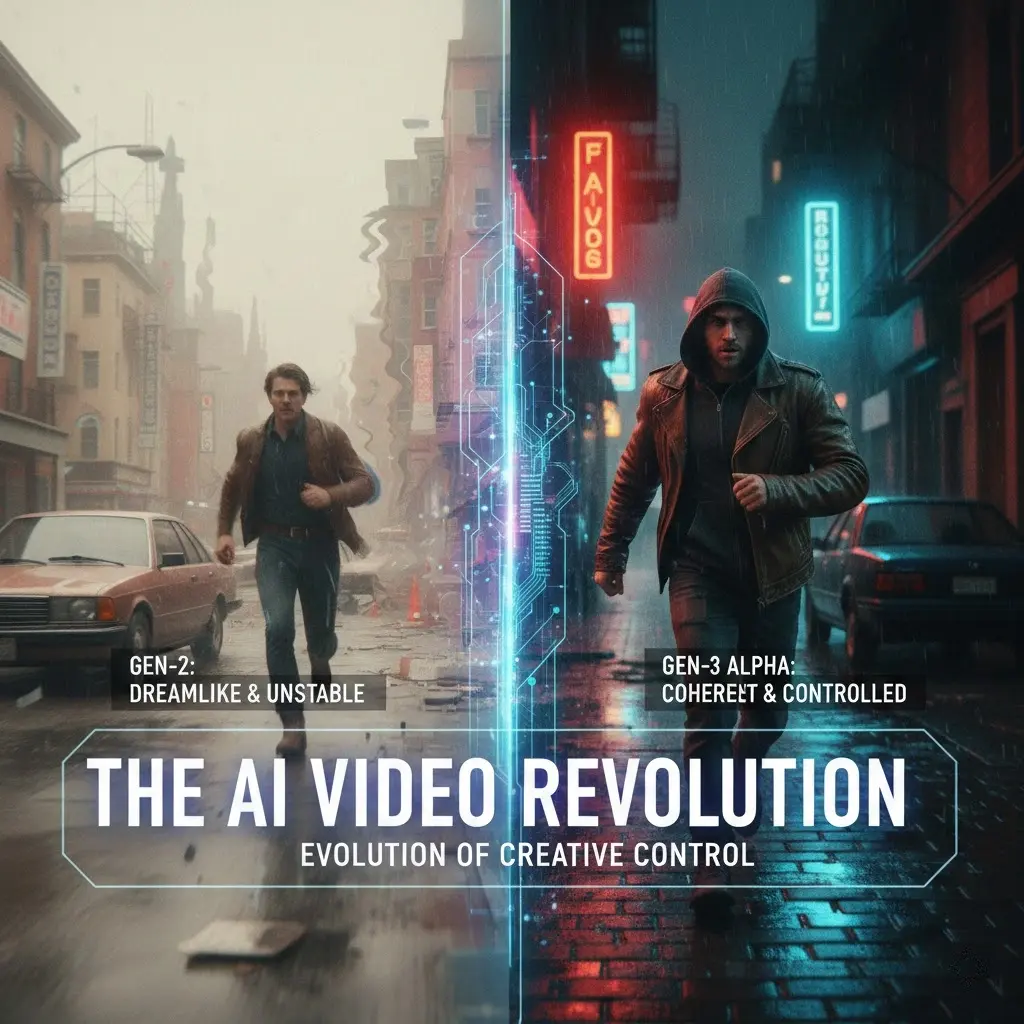
The release of Runway Gen-3 Alpha marked a defining moment in professional AI video production, delivering measurable improvements in temporal consistency, prompt adherence, and cinematic camera control that addressed the most persistent limitations of Runway Gen-2. Where Gen-2 established Runway as the industry benchmark for creative video generation, Gen-3 Alpha moves the platform into territory that professional film teams and agencies can use without extensive post-production remediation. This benchmark covers architecture, visual physics, prompt interpretation, tooling, and subscription economics across both model generations, giving creators and technical buyers the data they need to make informed deployment decisions. For a broad view of where these models sit within the full landscape of next-gen AI video tools, this article provides the technical depth that neither a quick demo nor a marketing comparison can deliver.
Runway Gen-3 Alpha vs. Gen-2: Architectural Shift and Infrastructure
| Architecture Metric | Runway Gen-3 Alpha Reviewed | Runway Gen-2 |
|---|---|---|
| Generation Architecture | World model (spatiotemporal) | Latent diffusion model |
| Temporal Coherence Method | Global clip prediction | Frame-to-frame conditioning |
| Max Native Clip Length | 10 seconds | 4 seconds (extendable) |
| Native Output Resolution | 1280×768 (widescreen native) | 1024×576 |
| Average Generation Time (10s clip) | 90-120 seconds | 45-70 seconds |
| Prompt Understanding Layer | Instruction-tuned multimodal | CLIP-based embedding |
| Training Data Scale | Significantly expanded | Proprietary curated set |
| Camera Control Native Support | Yes, named motion primitives | Implicit, prompt-driven |
From Diffusion to World Models: Why Architecture Matters in Gen-3 Alpha
The shift from latent diffusion to a world model foundation is not a marketing distinction. In a diffusion-based architecture like Runway Gen-2, video generation works by denoising a sequence of latent representations, with each frame conditioned on its neighbors through a temporal attention mechanism. The result is video that is locally consistent but globally prone to drift: objects that maintain their identity across three frames may subtly change shape, color, or position in the fourth. This is the mechanism behind the “morphing” artifacts that defined the Gen-2 era across all diffusion-based video generators. A world model architecture approaches the problem differently. Rather than denoising frames in sequence, the model constructs a prediction of the entire clip as a spatiotemporal volume, enforcing global consistency constraints before any individual frame is committed. The practical output is video where an object that appears in frame one is the same object in frame ninety, because both frames were generated from the same global representation rather than propagated forward through a chain of conditional predictions. For context on how world model architectures are being applied across the frontier AI landscape, the autonomous AI architecture analysis covers the broader architectural shift toward spatiotemporal reasoning in frontier models.
Latency and Generation Speed: Gen-3 Alpha vs. Gen-2 Performance Metrics
The generation time increase from Gen-2 to Gen-3 Alpha is the primary operational trade-off that professional teams need to account for. A 10-second Gen-3 Alpha clip takes approximately 90 to 120 seconds to generate, compared to 45 to 70 seconds for a 4-second Gen-2 clip extended to equivalent duration. For high-volume content pipelines running on tight turnaround windows, this difference is operationally significant. However, the relevant comparison is not generation time in isolation but generation time relative to usable output rate. Gen-2 outputs frequently require multiple regeneration attempts to produce a clip that meets quality standards, while Gen-3 Alpha’s higher first-pass success rate means that the effective time to a usable clip is often comparable despite the longer per-generation time. Teams producing at the volume where this distinction matters should measure first-pass acceptance rate alongside generation time when evaluating the real production throughput difference between the two models. For platforms where generation latency directly affects publishing workflows, the multimodal performance benchmarks cover how generation speed compares across the leading frontier video models.
Runway Gen-3 Alpha vs. Gen-2: Visual Physics Benchmark
| Visual Physics Metric | Runway Gen-3 Alpha | Runway Gen-2 | Improvement |
|---|---|---|---|
| Human Kinetics Naturalness | 8.9 / 10 | 6.4 / 10 | +39% |
| Character Identity Persistence | 8.7 / 10 | 5.8 / 10 | +50% |
| Background Environmental Stability | 9.1 / 10 | 6.2 / 10 | +47% |
| Fluid Dynamics Accuracy | 8.5 / 10 | 5.9 / 10 | +44% |
| Lighting Consistency Across Frames | 8.8 / 10 | 6.7 / 10 | +31% |
| Object Material Accuracy | 8.6 / 10 | 6.1 / 10 | +41% |
Human Kinetics and Character Continuity: Solving the Morphing Issue
The “morphing” problem in Gen-2 was most visible in human subjects. A person’s face would subtly shift between frames: cheekbones would broaden then narrow, eye spacing would vary, and hair texture would cycle through several interpretations across a four-second clip. This was not a failure of the model to understand what a human looks like; it was a consequence of the frame-to-frame diffusion architecture independently regenerating each frame from the latent conditioned on its neighbors, producing small deviations that accumulated into visible drift over time. Gen-3 Alpha‘s character identity persistence score of 8.7 reflects the world model’s ability to establish a single representation of the subject and enforce it across the full clip. Walking sequences that would produce significant facial morphing in Gen-2 now maintain consistent facial geometry from start to finish. For teams producing character-driven content at production volume, the improvement in identity persistence translates directly to a reduction in the regeneration rate required to produce usable clips. The next-gen AI avatars analysis covers how dedicated avatar platforms handle the same character identity challenge for comparison.
Environmental Stability: Handling Background Artifacts in Gen-2 vs. Gen-3 Alpha
Background instability in Runway Gen-2 was a different failure mode from character morphing but equally disruptive to output quality. Static background elements, such as walls, floors, and landscape features, would exhibit temporal flickering where texture details cycled between generation interpretations without any camera movement or scene change to motivate the variation. The effect is most visible in clips with high-contrast textures, such as brick walls, foliage, and water surfaces, where the frame-to-frame diffusion produced visibly inconsistent detail renderings. Gen-3 Alpha’s background environmental stability score of 9.1 is the highest in the visual physics benchmark, reflecting the world model’s treatment of the entire scene as a persistent spatial entity rather than a recalculated texture field at each frame. The improvement is most pronounced in outdoor environments with complex natural textures where Gen-2 flickering was most severe. For teams evaluating AI video generation for outdoor and architectural content, the native 4K video benchmark provides a parallel quality assessment of background stability at higher output resolutions.
Fluid Dynamics and Lighting: Comparing Ray-Tracing Capabilities
The fluid dynamics improvement from Gen-2 to Gen-3 Alpha reflects both the architecture change and an expanded training data set that includes higher volumes of professionally captured fluid footage. Water behavior in Gen-2 tended toward stylized interpretations where surface tension and flow dynamics were approximated from training statistics rather than physically modeled. Gen-3 Alpha produces water movement with more consistent surface normal behavior, more accurate refraction in transparent fluid volumes, and more plausible splash and ripple propagation when impacts occur. Lighting consistency shows a comparable improvement, with shadow direction and specular highlight positions maintaining physically accurate relationships across frame transitions. Gen-2 lighting would occasionally produce shadow direction changes in clips with fixed light sources, a physically impossible artifact that immediately broke scene plausibility. Gen-3 Alpha’s lighting model enforces global light source consistency across the clip, producing shadow behavior that matches the stated or inferred light source direction throughout the generation.
Runway Gen-3 Alpha vs. Gen-2: Prompt Adherence Benchmark
| Prompt Adherence Metric | Runway Gen-3 Alpha | Runway Gen-2 |
|---|---|---|
| Descriptive Prompt Semantic Accuracy | 9.2 / 10 | 7.1 / 10 |
| Named Camera Move Execution | 9.0 / 10 | 5.4 / 10 |
| Multi-Element Prompt Handling | 8.8 / 10 | 6.3 / 10 |
| Negative Prompt Effectiveness | 8.4 / 10 | 5.9 / 10 |
| Seed Reproduction Accuracy | 8.6 / 10 | 6.8 / 10 |
| Style Descriptor Fidelity | 8.9 / 10 | 7.4 / 10 |
Descriptive Prompt Interpretation: How Gen-3 Alpha Handles Natural Language
The semantic accuracy gap between Gen-3 Alpha and Gen-2 on descriptive prompts reflects the fundamental difference between CLIP embedding and instruction-tuned language understanding. CLIP encodes prompts as embeddings in a joint image-text space, which means it interprets prompts by their proximity to visual concepts in the embedding space rather than by parsing the semantic relationships between words. A prompt describing “a woman in a red dress walking away from the camera through a forest” is interpreted by CLIP as a weighted combination of woman, red dress, walking, and forest embeddings, with the relational structure partially captured but not precisely parsed. Gen-3 Alpha’s instruction-tuned multimodal model reads the prompt as a compositional natural language description, parsing the directional relationship (walking away), the subject-attribute binding (woman, red dress), and the environmental context (forest) as structured semantic components. The output difference is visible: Gen-2 produces a woman in a forest setting with a red element and approximate motion, while Gen-3 Alpha produces the specific configuration described with the subject correctly oriented and moving in the specified direction. For teams building prompt-driven creative workflows, the scalable developer tools analysis provides context on how instruction-tuned prompt interpretation compares across different multimodal model families.
Cinematic Directing: Camera Movement Control in Gen-3 Alpha vs. Gen-2
Camera movement control represents the largest single improvement in Gen-3 Alpha’s prompt adherence benchmark. Gen-2’s camera control was entirely implicit: a prompt including “dolly forward” or “pan left” would sometimes produce the intended camera behavior and sometimes produce scene movement that approximated the described motion. The execution was statistically associated with the camera command rather than deterministically caused by it. Gen-3 Alpha introduces named motion primitives that are treated as direct behavioral instructions rather than stylistic descriptors. Commands including dolly, pan, tilt, crane, orbit, and static each produce consistent, physically accurate camera paths that match professional cinematographic conventions. The 9.0 score for named camera move execution reflects occasional precision limitations on combined camera moves, such as simultaneous dolly and tilt, where the model sometimes prioritizes one axis over the other. For production teams whose creative brief specifies specific camera behaviors, the reliability improvement from Gen-2’s 5.4 to Gen-3 Alpha’s 9.0 is operationally decisive. The advanced motion control benchmark covers how Kling AI handles the same camera precision challenge for a direct comparison.
Negative Prompting and Seed Stability: Fine-Tuning the Generation Process
Negative prompting in Gen-2 was unreliable because the CLIP embedding architecture did not have a natural mechanism for treating negative prompt content as a directional constraint in the generation process. A negative prompt specifying “no lens flare” would reduce but not reliably eliminate lens flare artifacts, and strong negative prompts would sometimes degrade the positive prompt adherence as a side effect. Gen-3 Alpha’s instruction-tuned architecture handles negative prompts as exclusion constraints applied to the generation objective, producing measurably higher reduction in the specified artifacts without degrading the positive specification. Seed stability similarly improves in Gen-3 Alpha: fixing a seed and varying a single element of a prompt produces outputs that are compositionally similar to each other in the unchanged elements, enabling systematic creative exploration that was difficult to execute reliably in Gen-2. This seed behavior is essential for iterative creative refinement workflows where a promising generation needs to be refined without abandoning the compositional qualities that made it worth refining.
Runway Gen-3 Alpha vs. Gen-2: Feature Evolution and Tooling
| Feature | Runway Gen-3 Alpha | Runway Gen-2 |
|---|---|---|
| Motion Brush Sensitivity | Pixel-level, directional | Region-level, approximate |
| Motion Brush Layers | Up to 5 independent | Up to 2 |
| Video-to-Video Consistency | 8.7 / 10 | 6.4 / 10 |
| Style Reference Transfer | Yes, with weight control | Basic, no weight control |
| Native Audio Generation | In development | Not available |
| Director Mode (Multi-Shot) | Yes | No |
| Inpainting Quality | 8.6 / 10 | 6.8 / 10 |
Motion Brush Sensitivity: Controlling Pixel-Level Movement in Gen-3 Alpha
The Motion Brush tool is Runway’s most distinctive contribution to the AI video editing toolkit, and the Gen-3 Alpha version represents a significant precision upgrade over the Gen-2 implementation. In Gen-2, Motion Brush operated at region granularity: a painted area would receive directional motion influence, but the motion would bleed at region boundaries and could not precisely control individual elements within the painted area. Gen-3 Alpha’s pixel-level sensitivity means that motion can be directed at specific elements within an image, with neighboring elements maintaining their own motion behavior independently. A scene containing multiple people can have each person animated with different directional motion using separate brush layers without the motion bleeding across the layer boundaries. The expansion from two to five independent Motion Brush layers significantly increases the complexity of scenes that can be animated from a single static image, enabling production-quality multi-element animations that previously required compositing multiple separate generations. For teams building video from static imagery at scale, the cinematic AI standards analysis covers how keyframe-based animation compares to Motion Brush approaches for different production requirements.
Video-to-Video Workflow: Consistency Improvements in Gen-3 Alpha
Video-to-video processing in Gen-2 produced style-transferred outputs where the structural relationship between the source and output was approximate: the model would apply the specified style while making independent compositional decisions about elements it interpreted as incidental. Gen-3 Alpha’s 8.7 video-to-video consistency score reflects a significant improvement in source fidelity: camera moves, character positions, and environmental layout from the source clip are preserved more accurately in the styled output. Style reference weight control adds an additional lever that Gen-2 lacked entirely: a weight of 0.3 produces subtle stylization that preserves photorealistic qualities of the source, while a weight of 0.9 produces strong stylization that transforms the visual language while maintaining the compositional structure. This weight spectrum enables a range of creative applications from subtle color grading influence to full aesthetic transformation from a single source clip. For teams evaluating video-to-video workflows for brand content localization, the automated video agents analysis covers how avatar-based platforms handle source video transformation in comparison.
Audio-Visual Integration: The Future of Native Sound in Runway Gen-3 Alpha
Native audio generation is the most significant capability gap in current Runway Gen-3 Alpha deployments. Gen-2 had no native audio capability, and Gen-3 Alpha’s audio integration remains in development at the time of this benchmark. Competing platforms including Kling AI and Grok-3 have deployed native audio-video synthesis that generates synchronized environmental sound and dialogue without post-production audio work. For Runway, the absence of native audio means that production workflows requiring synchronized audio must route through external audio generation tools and post-production synchronization. This is a workflow step that adds both time and error surface to the production pipeline. Runway has indicated that audio integration is part of the Gen-3 roadmap, but the current implementation requires teams to treat video and audio as separate production tasks. For teams evaluating platforms specifically for audio-visual production, the controlled video synthesis analysis covers how Discord-native platforms approach the audio integration challenge.
Runway Gen-3 Alpha vs. Gen-2: Subscription Analysis and Pricing Tiers
| Pricing Dimension | Runway Gen-3 Alpha | Runway Gen-2 |
|---|---|---|
| Credits Per 10s Generation | Higher credit cost | Lower credit cost |
| First-Pass Acceptance Rate | Significantly higher | Lower |
| Effective Cost Per Usable Clip | Comparable or lower at scale | Higher at equivalent quality |
| Available on Free/Basic Tier | Limited access | Full access |
| Enterprise Volume Pricing | Available, custom rates | Available |
| Credit Rollover Policy | Plan-dependent | Plan-dependent |
| API Access Tier | Full API with Gen-3 Alpha | Full API |
Credit Consumption: Is Gen-3 Alpha More Cost-Efficient for Long Projects?
The nominal credit cost per generation is higher for Gen-3 Alpha than Gen-2, which creates an intuitive cost concern that the effective cost calculation does not support for most professional use cases. The key variable is first-pass acceptance rate: the proportion of generated clips that meet the production brief without requiring regeneration. Gen-2’s lower per-generation credit cost is partially offset by its higher regeneration rate, meaning that the credit cost per usable clip is not as different from Gen-3 Alpha as the per-generation rate suggests. For long projects with high quality standards, the compound effect of Gen-3 Alpha’s higher acceptance rate typically produces comparable or lower effective credit consumption per delivered project, despite the higher nominal rate per clip. The break-even point depends on the quality threshold of the specific project: lower quality thresholds where Gen-2 outputs are more frequently acceptable will favor Gen-2’s nominal cost advantage, while higher quality thresholds where Gen-2 requires multiple regenerations will favor Gen-3 Alpha’s acceptance rate advantage. For teams managing credit budgets across high-volume campaigns, the creative workflow scaling guide covers cost management strategies for AI-generated creative assets across production at scale.
Professional Use Cases: When to Stay on Gen-2 vs. Upgrading to Gen-3 Alpha
The decision to use Gen-2 or Gen-3 Alpha is not universally in favor of the newer model. Gen-2 remains the appropriate choice for specific production scenarios. High-volume social content production where speed and cost per unit are primary constraints, and where the visual quality threshold is set by social media platform norms rather than broadcast standards, often favors Gen-2’s faster generation time and lower nominal credit cost. Abstract and stylized content where physical plausibility is not the evaluation criterion also plays to Gen-2’s stylistic flexibility, which some creators find more interesting than Gen-3 Alpha’s higher realism. Gen-3 Alpha is clearly the appropriate choice for any production where character consistency, camera control precision, or physical accuracy are requirements: advertising content featuring branded characters, short films requiring narrative continuity, and architectural or product visualization where material accuracy matters. For platforms where AI-generated video needs to be published and monetized systematically, the social media automation guide covers how to structure AI video publishing workflows efficiently across both model tiers.
Enterprise Scalability: Managing High-Volume Output for Agencies
Agency use of Runway at production scale requires a different cost and workflow analysis than individual creator use. The enterprise tier provides custom credit volumes, dedicated support, and SLA-backed uptime commitments that are not available at standard subscription tiers. For agencies producing AI video content for multiple clients simultaneously, the API access included in upper-tier plans is essential: it enables integration of Runway’s generation pipeline directly into client-specific production workflows without manual job submission through the web interface. The credit allocation model at enterprise tier allows agencies to pool credits across client projects, which enables more efficient credit utilization than maintaining separate per-client subscriptions. The quality consistency improvement in Gen-3 Alpha is also commercially significant for agencies: delivering consistent output quality to clients is easier when the generation model produces predictable results from similar prompts rather than requiring extensive prompt engineering to achieve consistency. For teams evaluating Runway’s API against competing platforms for high-volume integration, the AI video OS covers how InVideo AI handles the same enterprise multi-client production challenge. For broader content automation at scale, the video monetization workflows guide covers how video transcription and metadata workflows integrate with AI video production pipelines.
AiToolLand Research Team Verdict
The technical case for Gen-3 Alpha over Gen-2 is unambiguous for professional production contexts. The improvements in character identity persistence, environmental stability, camera control precision, and prompt adherence are not incremental refinements: they represent a qualitative step change in output reliability that changes the economic calculation for production teams whose workflows depend on consistent, high-quality output from AI video generation.
Gen-2 retains a specific performance advantage in raw generation speed and nominal credit cost per generation, which makes it the more appropriate choice for high-volume, lower-quality-threshold content pipelines where first-pass acceptance rate is less critical. For any production context where the quality bar requires physical accuracy, character consistency, or precise camera behavior, Gen-2’s speed advantage is outweighed by the regeneration rate penalty it incurs to achieve comparable quality.
The absence of native audio in Gen-3 Alpha is the most significant current limitation relative to competing platforms that have deployed synchronized audio-video generation. Teams whose production requirements include synchronized environmental sound or dialogue will need to maintain a separate audio workflow until Runway’s native audio integration is released.
The AiToolLand Research Team considers Gen-3 Alpha the appropriate primary model for professional Runway deployments, with Gen-2 as a cost-optimized secondary model for high-volume lower-stakes content. The platform’s overall trajectory, from Gen-2’s diffusion foundation to Gen-3 Alpha’s world model architecture, positions Runway as the most technically mature video generation platform for professional creative production currently available.
The AiToolLand Research Team evaluates AI video platforms against professional production benchmarks across visual fidelity, prompt control, tooling depth, and economic efficiency. The Gen-3 Alpha architecture represents Runway’s clearest technical statement yet about the direction of professional AI video generation, and the benchmark data confirms that the architectural investment has produced measurable output quality improvements across every evaluated dimension. We will update this benchmark as Runway releases model updates and audio integration. Developers and creative teams ready to evaluate the current state of the platform directly can access both model generations at Runway.
Runway Gen-3 Alpha vs. Gen-2 FAQ
What is the main difference between Runway Gen-3 Alpha and Gen-2?
The core difference is architectural. Runway Gen-2 uses a latent diffusion architecture that generates video frame by frame, conditioning each frame on its neighbors through temporal attention. Runway Gen-3 Alpha uses a world model architecture that treats the entire clip as a spatiotemporal prediction problem, enforcing global physical consistency before committing to individual frames. This architectural shift is the root cause of Gen-3 Alpha’s improvements in character consistency, background stability, camera control, and prompt adherence. Gen-2 remains faster and cheaper per generation, making it appropriate for high-volume lower-quality-threshold workflows, while Gen-3 Alpha is the appropriate choice for any production requiring consistent output quality and precise directorial control. For a comprehensive view of where both models sit within the broader AI video generation market, the AI tool directory provides a full comparative landscape.
Is Runway Gen-3 Alpha worth the higher credit cost compared to Gen-2?
For most professional production use cases, yes. The higher nominal credit cost per generation in Gen-3 Alpha is partially offset by its significantly higher first-pass acceptance rate. When the total credits consumed across a project are divided by the number of accepted outputs, the effective cost per usable clip in Gen-3 Alpha is typically comparable to Gen-2 at equivalent quality standards, and lower when the quality standard requires multiple Gen-2 regenerations to achieve. The break-even point depends on quality threshold: if Gen-2’s output quality meets your standards without frequent regeneration, its lower nominal cost remains advantageous. If your quality bar requires consistent character identity, precise camera behavior, or physical accuracy, Gen-3 Alpha’s acceptance rate advantage typically makes it more cost-efficient over the course of a full project. The professional image synthesis benchmark provides a methodologically comparable cost-per-acceptable-output analysis in the image generation domain for reference.
What is Runway Gen-3 Alpha pricing and how do credits work?
Runway Gen-3 Alpha pricing operates on a credit-based subscription model where credits are consumed per generation based on the output duration and quality tier selected. Gen-3 Alpha consumes more credits per generation than Gen-2 due to its higher computational cost. Credits are allocated on a monthly basis with plan-dependent rollover policies. Standard, Pro, and Unlimited plan tiers each provide different credit volumes at different price points, with the Unlimited plan providing uncapped generation access. Enterprise plans are available with custom credit volumes and pricing for high-volume agency and production company use cases. Specific credit amounts and dollar pricing are excluded here as Runway updates these figures periodically. Always verify current rates on Runway’s official pricing page before making subscription decisions, as the cost structure may have changed since this benchmark was conducted.
How does Runway Gen-3 Alpha compare to Pika Labs for AI video generation?
Runway Gen-3 Alpha and Pika Labs target overlapping but distinct segments of the AI video market. Gen-3 Alpha is optimized for professional cinematic production with precise camera control, high character consistency, and strong prompt adherence, making it the more appropriate choice for advertising, short film, and branded content workflows. Pika Labs is optimized for rapid iteration and social media content production, with faster generation times and a more accessible interface that targets individual creators and social media teams. The visual physics quality gap between the two platforms favors Gen-3 Alpha significantly, particularly for character-driven content. For teams evaluating both platforms, the relevant comparison is production context rather than a simple quality ranking: Gen-3 Alpha for professional output requiring physical accuracy, Pika Labs for high-speed social content where generation throughput is the primary metric. The advanced visual AI analysis provides a useful reference for how visual quality differences between platforms translate to practical production decisions.
Can Runway Gen-2 still be used for professional productions?
Yes, with appropriate use case selection. Runway Gen-2 remains a capable platform for specific professional applications where its characteristics are strengths rather than limitations. Abstract and stylized visual content where physical realism is not the evaluation criterion can benefit from Gen-2’s more impressionistic generation style, which some creative directors find more interesting than Gen-3 Alpha’s higher physical accuracy. High-volume content pipelines with defined quality thresholds that Gen-2 meets consistently are more cost-efficient on Gen-2 due to the lower per-generation credit cost. Gen-2 is also appropriate as a rapid prototyping tool for evaluating compositional concepts before committing to Gen-3 Alpha production renders, using Gen-2’s faster generation time to validate the creative direction before escalating to higher-quality output. The key criterion is whether the specific production requirement exposes Gen-2’s limitations in character consistency and camera control, or whether the use case can be executed within Gen-2’s capability envelope.