
 By
/ March 5, 2026
By
/ March 5, 2026 Rytr AI Review: Is This the Most Practical AI Writing Tool for Content Teams?
If your team has been looking for an AI writing tool that does not require a steep learning curve, a bloated subscription tier, or a complete workflow overhaul, Rytr AI belongs at the top of your evaluation list. Unlike many competitors that prioritize feature breadth over everyday usability, Rytr AI is purpose-built for writers, marketers, and content teams who need reliable output fast. It can expand short notes into full articles, rewrite paragraphs in place, and brainstorm ideas inside a single interface, all without switching platforms. This review benchmarks Rytr AI against Jasper AI, Writesonic, and Copy.ai to give you a clear, evidence-based picture of where each tool genuinely leads and where trade-offs exist.
What Is Rytr AI and How Does It Fit Into a Modern Content Workflow?
Rytr AI is a cloud-based AI writing assistant built around use-case templates, tone controls, and a lightweight editor. It works directly inside its own interface and extends into Google Docs, WordPress, Slack, and LinkedIn via a browser extension, meaning writers can access AI assistance without leaving the platforms they already use every day.
Rytr launched as one of the earlier dedicated AI writing tools in the market and has since built a reputation for being genuinely accessible to solo creators and small teams. Its core mechanic is simple: choose a use case from over forty prebuilt templates, set your tone of voice, and provide a brief input. The model returns structured output in seconds, covering everything from blog introductions and email subject lines to product descriptions and social media captions.
What separates Rytr from generic chatbot-style writing tools is its template architecture. Rather than prompting an open-ended model and hoping for consistent formatting, Rytr constrains outputs to specific content types. This means a user generating a blog section gets a result that already resembles a polished blog section, not a raw language model response that still needs heavy editing. For teams processing high volumes of short and medium-length content, this structure meaningfully reduces post-processing rough notes into publishable form.
Understanding where Rytr fits requires placing it against the wider landscape of leading LLM platforms that now power every tier of content software, from simple editors to enterprise writing suites.
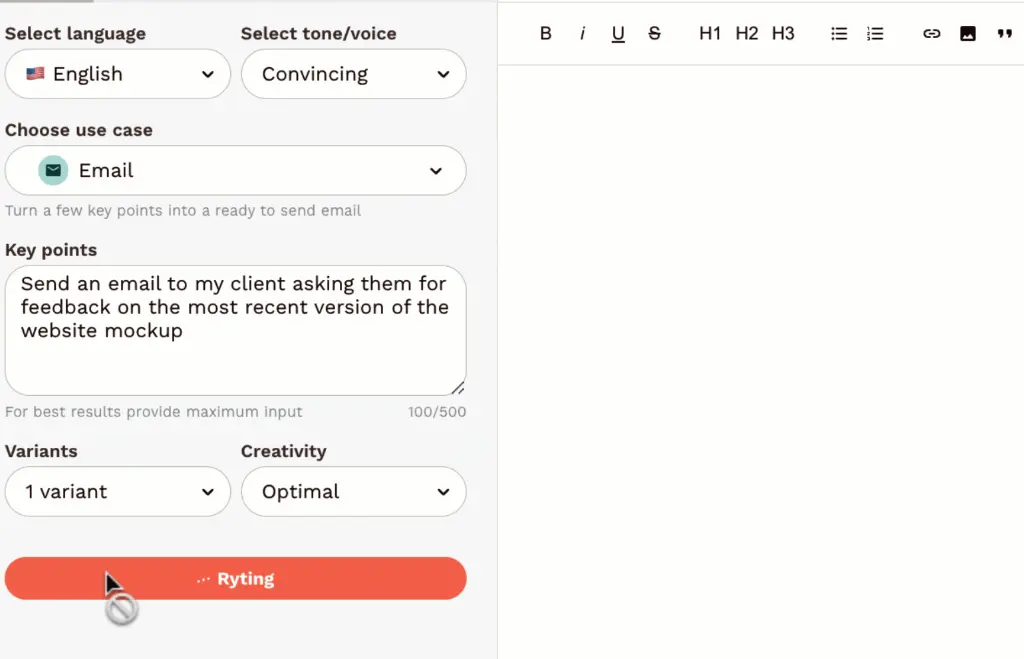
Use Rytr’s tone selector deliberately. Setting “Convincing” for sales copy and “Informative” for editorial content produces noticeably different outputs from the same input. Matching tone to content type is the single fastest way to reduce editing time per piece.
Core AI Writing Features That Make Rytr Stand Out
Rytr AI covers the full short-to-medium content lifecycle: drafting, expanding, rewriting, and refining. Its most operationally useful features include template-integrated AI prompts, a built-in plagiarism checker, an SEO analyzer, and a browser extension that brings AI assistance directly into Google Docs, WordPress, Slack, and LinkedIn without context switching.
| Feature Category | Rytr AI Capability | Output Format |
|---|---|---|
| Content generation | Expand short notes into full articles, draft SOPs from bullet points | Formatted text blocks |
| Rewriting and editing | Rewrite paragraphs in place, clean up grammar without leaving workspace | Inline replacement |
| Ideation | Brainstorm ideas inside workspace, break down goals into task lists | Bulleted list or paragraph |
| Summarization | Extract key points from long documents, generate summaries directly in docs | Condensed paragraph or bullets |
| SEO and quality checks | Built-in SEO Analyzer, Plagiarism Checker | Score and flagged suggestions |
| Platform reach | Google Docs, WordPress, Slack, LinkedIn via browser extension | Inline assistant overlay |
| Template system | Template-integrated AI prompts across 40+ use cases | Use-case structured output |
Expand Short Notes Into Full Articles
Rytr’s “Blog Section Writing” and “Blog Idea and Outline” templates make it straightforward to move from a rough brief to a full draft. Feed in a topic sentence or a handful of bullet points and Rytr structures a section with a clear opening, supporting body text, and a natural close. Teams that consistently need to expand short notes into full articles without hiring additional writers find this feature particularly valuable for scaling editorial output on a constrained budget.
Rewrite Paragraphs in Place
The rephrase feature lets you highlight any block of generated or imported text and request a rewrite at a different reading level, tone, or length. This is not a surface-level synonym swap; the model restructures sentences while preserving meaning. Writers who need to adapt a single piece of content for multiple audiences, such as a technical audience and an executive summary audience, can iterate through variations in seconds rather than rewriting from scratch. The ability to rewrite paragraphs in place inside the same editor eliminates the need to copy content between tools.
For teams that also need to produce polished marketing copy alongside editorial content, understanding how Rytr compares to purpose-built tools for AI content creation helps set the right expectations for each workflow.
Built-In SEO Analyzer and Plagiarism Checker
One of Rytr’s most differentiating features relative to comparable tools is the inclusion of both an SEO Analyzer and a Plagiarism Checker inside the same interface. Most competing tools require third-party integrations or separate subscriptions to cover these checks. Rytr allows writers to verify that content meets basic SEO structure requirements and passes originality checks before it ever leaves the editor. For content teams operating under strict publication standards, having these quality gates built into the writing environment rather than layered on top afterward is a meaningful workflow advantage.
Template-Integrated AI Prompts and Variable-Based Content Generation
Rytr’s template system is what sets its output consistency apart from open-ended chat interfaces. Each template carries embedded instructions that shape how the model frames a response. When combined with custom inputs, this creates what practitioners call variable-based content generation: swap the product name, target audience, or key benefit and get a structurally consistent output every time. For agencies managing multiple client accounts, this repeatability dramatically reduces the per-piece setup time compared to crafting a fresh prompt for every content request.
Build a custom use case in Rytr for your most repeated content type. Whether that is a weekly newsletter section, a product update post, or a client-facing brief, saving a custom template means your team starts every piece from a structure that already fits your brand voice rather than a generic default.
Rytr AI vs. Jasper AI vs. Writesonic vs. Copy.ai: Full Benchmark
Across the four tools benchmarked, Rytr AI leads on accessibility, pricing efficiency, and built-in quality checks. Jasper AI dominates for enterprise brand voice consistency and long-form SEO content. Writesonic excels at real-time web-grounded content generation. Copy.ai is the strongest option for sales-focused and CRM-integrated copy workflows. No single tool wins every category.
| Capability | Rytr AI | Jasper AI | Writesonic | Copy.ai |
|---|---|---|---|---|
| Expand short notes into full articles | Excellent Best | Excellent | Good | Moderate |
| Rewrite paragraphs in place | Excellent Best | Excellent | Good | Good |
| Template-integrated AI prompts | Excellent Best | Excellent | Good | Good |
| Variable-based content generation | Good | Excellent Best | Good | Excellent |
| Built-in plagiarism checker | Yes Best | Via integration | Via integration | No |
| Built-in SEO analyzer | Yes Best | Via Surfer SEO | Yes | No |
| Browser extension reach | Excellent Best | Good | Moderate | Good |
| Long-form brand voice consistency | Moderate | Excellent Best | Good | Good |
| Real-time web-grounded content | Limited | Good | Excellent Best | Moderate |
| Sales and CRM copy integration | Moderate | Good | Good | Excellent Best |
| Eliminating context switching | Excellent Best | Good | Moderate | Moderate |
| Entry-level pricing accessibility | Excellent Best | Limited | Good | Good |
| Performance Dimension | Rytr AI | Jasper AI | Writesonic | Copy.ai |
|---|---|---|---|---|
| Output quality for short copy (1-10) | 8.9 | 8.7 | 8.2 | 8.5 |
| Output quality for long-form (1-10) | 7.6 | 9.1 | 8.0 | 7.4 |
| Onboarding speed | Very fast | Moderate | Fast | Fast |
| Native quality gates | SEO + Plagiarism | Brand voice | SEO | None |
| Learning curve | Low | Medium-High | Medium | Medium |
| Team collaboration features | Basic | Strong | Moderate | Strong |
Where Jasper AI Competes Seriously
Jasper AI is the tool that professional content teams at scale turn to when brand voice consistency across thousands of pieces is non-negotiable. Its Brand Voice feature ingests your existing content and trains the model to match your specific tone and style at a level that Rytr’s tone selector cannot replicate for complex or highly differentiated brands. For enterprise marketing departments, Jasper’s depth in long-form SEO content and its integration with Surfer SEO represent a meaningful advantage.
Teams evaluating how AI writing tools handle the full content supply chain, including video scripts and transcription-based repurposing, will want to understand how they can also repurpose video content alongside written output to maximize production efficiency.
Where Writesonic Leads
Writesonic’s primary differentiator is its ability to ground content generation in real-time web data. Its Chatsonic feature connects to current search results, making it the most capable of the four tools for generating content about recent events, trending topics, or time-sensitive industry news. For content teams that publish frequently about fast-moving subjects, Writesonic’s web connectivity is a structural advantage that template-based tools cannot replicate without manual research input. Teams managing social publishing alongside content drafting will want to evaluate how these platforms pair with an AI for Instagram marketing scheduler to close the loop between written output and social distribution.
Where Copy.ai Pulls Ahead
Copy.ai has made a deliberate strategic move toward GTM (go-to-market) workflows, embedding AI copy generation directly into sales pipeline and CRM contexts. Its ability to generate dynamic ad copy at scale, personalized outreach sequences, and sales email variations with consistent brand positioning makes it the strongest choice for revenue-focused teams rather than pure content production teams. Keeping pace with how AI autonomy is developing in this space is easier when you follow the trajectory of experimental AI agents that are pushing the boundaries of what automated content workflows can accomplish.
When benchmarking these four tools for your own team, test each one on your three most common content types using identical briefs. Generic benchmark scores reflect averaged performance; your specific content mix may shift the rankings considerably. Rytr tends to outperform expectations on short structured copy while Jasper closes the gap on longer, research-backed articles.
Real-World Use Cases Where Rytr AI Delivers Consistent Results
Rytr AI performs most consistently for content teams handling high volumes of short and medium-length pieces: social captions, email sequences, product descriptions, blog sections, and landing page copy. Its browser extension reach into LinkedIn, Slack, WordPress, and Google Docs makes it particularly valuable for teams that want AI assistance embedded in the platforms they already use rather than a separate writing environment.
| Use Case | Rytr Feature Used | Time Saving Potential |
|---|---|---|
| Blog drafting and expansion | Expand short notes into full articles, Blog Section template | Very high |
| Email marketing sequences | Email template, variable-based content generation | High |
| Social media captions | Social media template, AI for Instagram marketing contexts | High |
| Product descriptions | Product Description template, rewrite in place | Very high |
| LinkedIn posts and outreach | Browser extension on LinkedIn, tone selector | High |
| Content briefs and outlines | Create project briefs from raw notes, Blog Outline template | Moderate |
| Internal documentation | Draft SOPs from bullet points, generate FAQs from internal documentation | Moderate |
Drafting Structured Project Briefs
Content agencies and in-house marketing teams frequently use Rytr to convert raw client inputs into structured content briefs. A typical workflow involves pasting unorganized notes from a client call into Rytr, selecting a relevant template, and letting the model produce a draft brief with clear objectives, target audience, key messages, and suggested structure. Drafting structured project briefs this way compresses what used to be a thirty-minute manual task into a two-minute editing pass.
Summarizing Long-Form Technical Docs
Technical writers and product marketers use Rytr’s summarization capability to condense lengthy documentation, release notes, or research papers into digestible summaries. The ability to summarize long-form technical docs and extract key points from long documents is particularly useful when creating customer-facing knowledge base articles from dense internal materials. This positions Rytr as a practical bridge between subject matter experts who write for depth and audiences who need clarity.
Writers who use Rytr for content production and then want to verify output originality before publishing can pair it with a dedicated plagiarism and AI detector as a secondary check alongside Rytr’s own built-in tool.
Generating FAQs From Internal Documentation
One underused Rytr workflow involves feeding existing help documentation or product guides into the editor and prompting it to generate FAQs from internal documentation. The output serves two purposes: it creates customer-facing FAQ content and simultaneously surfaces gaps in the source material where answers are vague or incomplete. Support teams and content strategists have adopted this approach to build out knowledge bases faster than traditional Q&A writing methods allow.
For teams building content workflows that extend beyond written copy into video and visual formats, exploring AI video production tools alongside Rytr creates a more complete multi-format content pipeline.
Install the Rytr browser extension and activate it during your next LinkedIn post drafting session or WordPress article upload. Using AI assistance directly inside the platform where you publish removes the copy-paste step entirely, which sounds minor but adds up to significant time savings across a week of regular content publishing.
Rytr AI Pricing Structure and What Teams Need to Know About Data Handling
Rytr offers one of the most accessible pricing structures in the AI writing tool category, with a free tier that provides meaningful functionality and paid plans that scale without the steep jump seen in enterprise-first competitors like Jasper. On data handling, Rytr does not use customer content to train its models, which is a baseline expectation for teams with content confidentiality requirements.
| Pricing and Access Dimension | Rytr AI | Jasper AI | Writesonic | Copy.ai |
|---|---|---|---|---|
| Free tier availability | Yes Best | No | Yes (limited) | Yes (limited) |
| Entry paid plan accessibility | Very low cost Best | High cost | Moderate cost | Moderate cost |
| Character or word limits on paid plans | Unlimited on top plan | Unlimited | Credit-based | Credit-based |
| Uses customer data to train models | No | No | No | No |
| GDPR compliance | Yes | Yes | Yes | Yes |
| Team seats on entry plans | Single user | Multiple seats | Multiple seats | Multiple seats |
Token Efficiency and Output Volume
Rytr’s paid plans are structured around character output rather than token consumption in the developer sense, making usage predictable for non-technical content teams. Writers do not need to think about prompt optimization for cost efficiency the way API users do. For teams comparing total cost of ownership across tools, Rytr’s model consistently delivers more usable output per billing unit at the entry level than any of the three competitors in this benchmark, which is a material advantage for bootstrapped content operations and growing agencies.
Native AI vs. Browser Extensions Across the Competitive Set
All four tools in this benchmark offer some form of browser extension or platform integration, but Rytr’s extension coverage is the broadest of the group at this pricing tier. The debate around native AI vs. browser extensions matters here because extensions introduce different privacy surface areas than fully native tools. Rytr’s extension communicates with its own servers rather than routing content through third-party AI APIs that users have no direct relationship with, which is a meaningful distinction for teams handling proprietary or sensitive content. For teams already using an integrated workspace AI for knowledge management, Rytr complements rather than replaces that layer by covering the active writing and editing surface.
Teams that publish written content alongside grammar-perfected final drafts will find value in understanding how Rytr’s built-in cleanup compares to dedicated grammar checking tools at the refinement stage.
Start Rytr on the free plan and run it in parallel with your current writing tool for two weeks. Track how many first drafts you produce with each tool and measure editing time per piece. The free tier is generous enough to give a real signal before committing to a paid plan.
Who Should Use Rytr AI and When a Competitor Makes More Sense
Rytr AI is the strongest fit for freelancers, content agencies, small marketing teams, and individual creators who need fast, reliable short-to-medium content output without an enterprise budget. Teams with complex brand voice requirements, real-time web content needs, or deep CRM integration will find Jasper, Writesonic, or Copy.ai better aligned to those specific demands.
| Team Profile | Rytr AI Fit | Alternative to Consider |
|---|---|---|
| Freelance writers and bloggers | Excellent Best fit | None needed at this scale |
| Content agencies (high volume) | Excellent Best fit | Jasper for brand voice depth |
| Small marketing teams | Excellent Best fit | Writesonic if web grounding needed |
| Enterprise brand content teams | Moderate | Jasper AI for scale and consistency |
| Sales and GTM teams | Moderate | Copy.ai for CRM integration |
| News and trending content publishers | Limited | Writesonic for real-time web data |
| Students and academic writers | Good | Pair with dedicated advanced paraphrasing tools |
When Rytr AI Works Best
Rytr AI consistently delivers its strongest results when used for structured short content at volume. A content agency producing weekly blog posts, email newsletters, and social captions for multiple clients gets the most return from Rytr because the template system handles the structural scaffolding automatically, leaving writers to focus on tone, accuracy, and client-specific customization. The built-in SEO Analyzer and Plagiarism Checker remove two post-writing quality steps from the workflow, which compounds into significant time savings across a week of production.
Teams exploring how AI assists different creative and technical writing tasks will benefit from understanding the evolving capabilities of community driven AI models that increasingly power both commercial tools and open-weight alternatives in this space.
When to Choose a Competitor
The clearest signal to choose Jasper over Rytr is when your organization has invested in a documented brand voice guide and needs every output, regardless of which team member runs the prompt, to sound like it came from the same voice. Rytr’s tone selector is effective but surface-level compared to Jasper’s trained brand voice feature. Similarly, if your content strategy depends heavily on real-time news hooks and trending topic angles, Writesonic’s web-connected generation is a structural capability that Rytr does not currently match. For visual content teams that also need AI-generated imagery alongside written copy, understanding professional AI art tools as a complement to Rytr rounds out the production stack. The broader context of how these tools fit within the evolving ethical AI guidelines landscape is also worth tracking as content teams formalize their AI usage policies.
If you are managing content for multiple clients with different brand voices, create a separate Rytr custom use case for each client’s primary content type. Storing brand-specific tone cues and vocabulary in a custom template saves the briefing step for every new piece and keeps output drift low across large monthly content volumes.
Frequently Asked Questions About Rytr AI
What is Rytr AI best used for?
Rytr AI is best suited for short to medium-length content production at volume. Its strongest use cases include blog section drafting, email sequences, product descriptions, social media captions, and LinkedIn posts. The template system makes it particularly efficient for recurring content types where structural consistency matters, and its browser extension extends this capability directly into Google Docs, WordPress, Slack, and LinkedIn without context switching.
How does Rytr AI compare to Jasper AI?
Rytr AI leads on accessibility, pricing, onboarding speed, and built-in quality checks including its SEO Analyzer and Plagiarism Checker. Jasper AI leads on long-form content quality, trained brand voice consistency, and enterprise team collaboration features. For small teams and freelancers, Rytr delivers comparable short-form output quality at a fraction of the cost. For large brand teams requiring documented voice compliance at scale, Jasper is the more defensible choice.
Does Rytr AI have a free plan?
Yes. Rytr offers a free tier that provides access to core writing features with a monthly character limit. The free plan is sufficient to evaluate the template system, tone controls, and output quality before committing to a paid tier. It is one of the most functional free plans in the AI writing tool category, making it a practical starting point for freelancers or teams piloting AI content tools for the first time.
Can Rytr AI write full blog posts?
Rytr can draft full blog posts using its Blog Idea, Blog Outline, and Blog Section templates in sequence. It is most effective when used section by section rather than generating an entire post in a single prompt. This structured approach produces more coherent and on-topic output than asking for a full article at once. Writers typically use Rytr to generate a first draft that then requires light editing for accuracy, brand fit, and SEO refinement before publication.
Does Rytr AI check for plagiarism?
Yes. Rytr includes a built-in Plagiarism Checker that scans generated content against web sources before you publish. This is a differentiating feature among tools at Rytr’s price tier, as most competitors require a third-party integration or separate subscription to run plagiarism checks. For content teams with publication standards that require originality verification, having this check inside the writing environment removes a step from the post-production workflow.
Is Rytr AI suitable for SEO content?
Rytr is a practical tool for SEO content at the drafting stage, particularly for teams producing blog posts, meta descriptions, and structured page copy. Its built-in SEO Analyzer provides basic scoring and suggestions before content leaves the editor. For advanced SEO workflows requiring deep keyword research integration, SERP analysis, or content scoring against top-ranking competitors, pairing Rytr with a dedicated SEO platform will produce stronger results than relying on Rytr’s native SEO features alone.
Which platforms does Rytr’s browser extension support?
Rytr’s browser extension currently supports Google Docs, WordPress, Slack, and LinkedIn. This means writers can access Rytr’s AI assistance as an inline overlay while working inside those platforms, removing the need to switch to the Rytr editor to generate or refine content. The extension is available for Chrome-based browsers and covers the most commonly used content creation and professional communication platforms for most marketing and content teams.
How does Rytr AI handle data privacy?
Rytr does not use customer-generated content to train its AI models, which is the baseline privacy commitment content teams should look for in any AI writing tool. The platform is GDPR compliant, covering teams operating under European data protection standards. For teams handling highly sensitive client content or proprietary information, reviewing Rytr’s current data processing agreement directly before onboarding is always advisable given how frequently privacy policies evolve in this category.
Can Rytr AI generate content in multiple languages?
Yes. Rytr supports content generation in over thirty languages, making it a viable option for multilingual content teams and global marketing operations. Output quality varies by language, with English-language content consistently producing the strongest results. For teams whose primary content output is in languages other than English, running a direct quality comparison using your actual content types before committing to a plan is recommended.
Is Rytr AI worth it for a solo content creator?
For solo creators, Rytr AI offers one of the strongest value propositions in the AI writing tool market. The free tier provides enough functionality to meaningfully accelerate content production, and the paid upgrade is priced accessibly relative to the time it saves on drafting and editing. Solo bloggers, newsletter writers, and freelance copywriters consistently cite Rytr as the tool that removed the blank-page problem from their workflows without requiring the budget or complexity of enterprise-tier alternatives.
AiToolLand Research Team Verdict: Rytr AI
Rytr AI earns a strong recommendation for content teams, freelancers, and growing agencies that need reliable, fast, and affordable AI writing assistance without the overhead of enterprise-tier platforms. Its template architecture delivers structural consistency that open-ended chat interfaces cannot match at the same speed, and the inclusion of both a Plagiarism Checker and SEO Analyzer inside the same environment removes two common post-writing friction points from the content workflow.
The benchmark comparison in this review makes clear that no single tool dominates every dimension. Jasper AI remains the benchmark for enterprise brand voice at scale, Writesonic leads for web-grounded real-time content, and Copy.ai is the rational choice for sales and GTM copy workflows. But for the widest range of everyday content production tasks, especially at the volume and budget constraints most independent teams operate under, Rytr AI delivers a better return on investment than any of its three main competitors in this review.
Its extension reach into Google Docs, WordPress, Slack, and LinkedIn is a practical differentiator that reduces context switching for writers who spend their day across multiple platforms. Pair that with accessible pricing and a functional free tier, and Rytr AI makes a compelling case as the default AI writing layer for content operations that are not yet ready, or simply do not need, a full enterprise suite.
Transparency note: AiToolLand does not have a commercial relationship with Rytr. This assessment reflects independent editorial evaluation. Scores and recommendations are subject to revision as product capabilities evolve.
External links open in a new tab. AiToolLand is not affiliated with Rytr. All external links are independent references.
Rytr AI is one of those tools that quietly outperforms expectations once you move past the feature list and spend time inside it. The template system feels opinionated in the best way, guiding output toward usable results rather than leaving writers to wrestle with prompt engineering. After thorough evaluation across writing, rewriting, summarization, and quality-check workflows, the Research Team considers Rytr AI the most accessible entry point into professional AI-assisted content production available in its pricing tier. For content teams that want AI to serve their process rather than replace it, Rytr AI is a practical and well-considered choice.
Last updated: March 2026